MARKETING MANAGEMENT · STUDY NOTES
0% read
Mind Map
UNIT V · Simple English · Complete PDF study notes

Competitive Dynamics & Responsible Marketing

See how firms compete, protect their positions and market products with social and environmental responsibility. Every section follows the supplied lecture material, with a clear meaning, useful examples and slide references.

Select a chapter above. Scroll down to read the notes in order.

What this chapter contains

Made for understanding the material from the beginning, not just memorising headings.

Lecture PDF pages19
Study sections9
Important concepts36
01 · Competitive Dynamics & Responsible Marketing

Four competitive positions

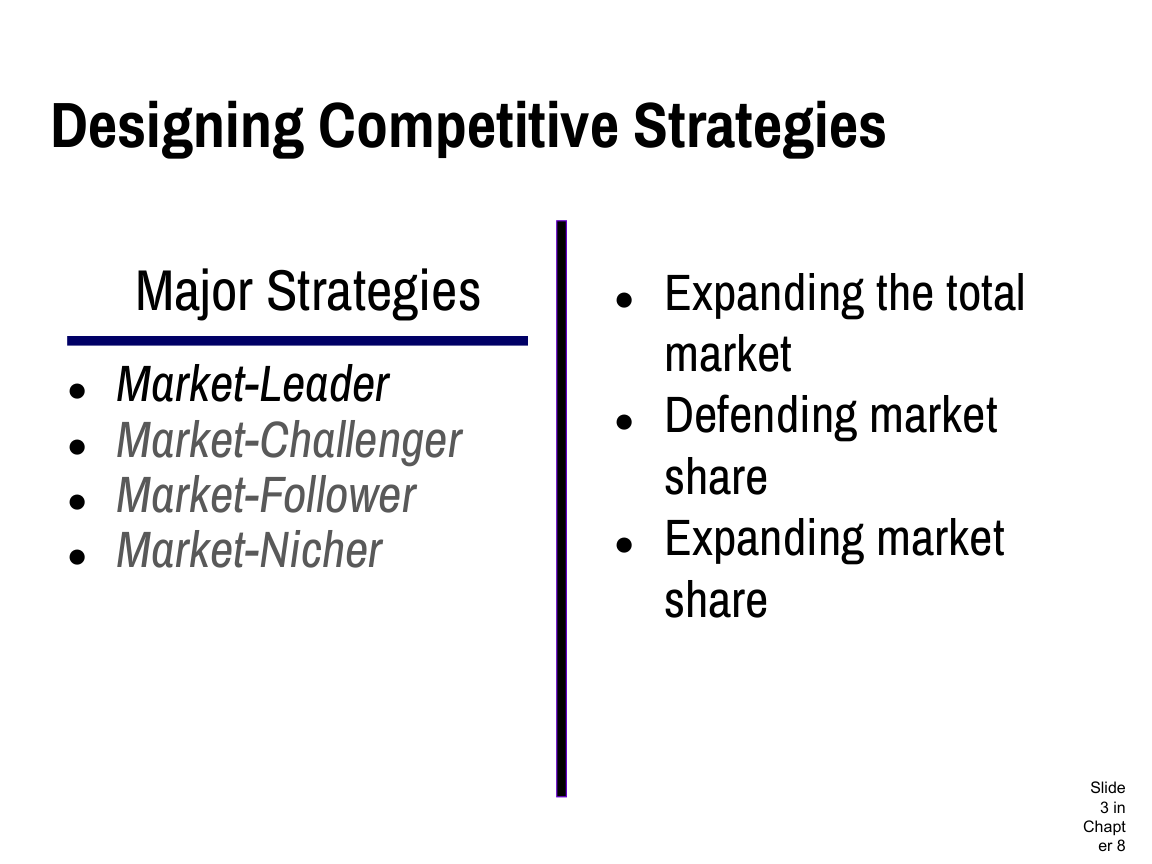
Businesses can hold different places in a market. A leader has a strong share, a challenger tries to gain share, a follower competes more cautiously and a nicher focuses on a smaller group of customers.

In one sentence

The lecture distinguishes market leaders, challengers, followers and nichers. Leaders typically defend or grow leadership; challengers attack; followers imitate or adapt carefully; nichers specialise. The right strategy depends on resources and market position.

Market leader, challenger, follower and nicher
Original lecture diagram · PDF page 3. Market leader, challenger, follower and nicher · Open page

Market leader strategy

UNDERSTAND THE IDEA

A market leader usually has the largest share within its market. It tries to increase overall demand, protect its existing position and, where worthwhile, grow its share further.

IN REAL LIFE

The largest neighbourhood supermarket improves stock availability and loyalty rewards to retain buyers. The firm tries to protect and expand its leading position.

Remember: The firm tries to protect and expand its leading position.

Market challenger strategy

UNDERSTAND THE IDEA

A market challenger is a strong competitor trying to gain share from larger rivals. It may attack their main offering directly, serve neglected customer groups or enter less contested markets.

IN REAL LIFE

A smaller grocery chain targets customers whose neighbourhood has limited fresh-food options. The challenger attacks an unmet need rather than copying every rival offer.

Remember: The challenger attacks an unmet need rather than copying every rival offer.

Market follower strategy

UNDERSTAND THE IDEA

A market follower competes without directly challenging the leader for dominance. It may adapt proven ideas and focus on efficiency or an attractive customer group.

IN REAL LIFE

A minor detergent producer adopts common pack sizes and industry-standard selling practices. It avoids direct confrontation with the largest brands.

Remember: It avoids direct confrontation with the largest brands.

Market nicher strategy

UNDERSTAND THE IDEA

A market nicher concentrates on a smaller, specialised group whose needs are not fully served by large competitors. Its advantage comes from understanding that group unusually well.

IN REAL LIFE

A small retailer specialises entirely in equipment for long-distance cyclists. Deep expertise serves a narrow audience.

Remember: Deep expertise serves a narrow audience.

See the original lecture slides and exact terminology

These extracts follow the lecturer’s slide order. Some original PDF lines are short fragments; select a slide number to see the complete original page.

  • Competitive Dynamics: Competitive Strategies for Market,
  • Other Competitive Strategies – Market Challenger
  • Strategies Market Follower Strategies, Market Nicher
  • Sustainable Marketing, Social Criticisms of Marketing,
  • Marketing’s Impact on Individual, on Society as a Whole,
  • and on Other Businesses, Actions to Promote Sustainable
  • Marketing, importance of Ethics in Marketing Practice.
  • Designing Competitive Strategies
  • Major Strategies
  • Market-Leader
  • Market-Challenger
  • Market-Follower
  • Market-Nicher
  • Expanding the total
  • Defending market
  • Expanding market
02 · Competitive Dynamics & Responsible Marketing

Expanding the total market

A market leader can grow by attracting new users, encouraging new ways of using the product or increasing how often current users buy it.

In one sentence

Leaders may develop new users, new uses or more frequent product consumption. The slide specifically lists penetration, new-market and geographic expansion alongside usage stimulation.

Expand total market

UNDERSTAND THE IDEA

Leaders may develop new users, new uses or more frequent product consumption. The slide specifically lists penetration, new-market and geographic expansion alongside usage stimulation. For expand total market specifically, the important distinction is: growth comes from total category demand rather than only stealing a rival's customers.

IN REAL LIFE

A tea producer encourages new groups to try tea and suggests additional occasions to consume it. Growth comes from total category demand rather than only stealing a rival's customers.

Remember: Growth comes from total category demand rather than only stealing a rival's customers.

Find new users

UNDERSTAND THE IDEA

Leaders may develop new users, new uses or more frequent product consumption. The slide specifically lists penetration, new-market and geographic expansion alongside usage stimulation. For find new users specifically, the important distinction is: the brand identifies a new group of possible buyers.

IN REAL LIFE

A breakfast-cereal brand introduces simple recipe ideas to reach adults who previously thought cereal was only for children. The brand identifies a new group of possible buyers.

Remember: The brand identifies a new group of possible buyers.

Promote new product uses

UNDERSTAND THE IDEA

Leaders may develop new users, new uses or more frequent product consumption. The slide specifically lists penetration, new-market and geographic expansion alongside usage stimulation. For promote new product uses specifically, the important distinction is: new applications can expand demand.

IN REAL LIFE

A baking-soda company explains safe household cleaning uses in addition to cooking. New applications can expand demand.

Remember: New applications can expand demand.

Encourage greater product use

UNDERSTAND THE IDEA

Leaders may develop new users, new uses or more frequent product consumption. The slide specifically lists penetration, new-market and geographic expansion alongside usage stimulation. For encourage greater product use specifically, the important distinction is: regular use may increase category consumption when the guidance is accurate.

IN REAL LIFE

A toothpaste brand explains appropriate twice-daily brushing in a dental-health campaign. Regular use may increase category consumption when the guidance is accurate.

Remember: Regular use may increase category consumption when the guidance is accurate.

See the original lecture slides and exact terminology

These extracts follow the lecturer’s slide order. Some original PDF lines are short fragments; select a slide number to see the complete original page.

  • Designing Competitive Strategies
  • Expanding the Total Market:
  • Targeting Product to New Users
  • Market-penetration strategy
  • New-market strategy
  • Geographical-expansion strategy
  • Promoting New Uses of Product
  • Encouraging Greater Product Use
03 · Competitive Dynamics & Responsible Marketing

Challenger attack strategies

A market challenger tries to win customers from rivals. It can attack a competitor directly, serve a neglected group, enter different markets or use better prices, products and distribution.

In one sentence

A challenger defines goals and opponents, then chooses general and specific strategies. Frontal attack meets a rival directly; flank attack serves neglected needs; bypass attack enters easier markets or technologies. Specific tactics include price, service, product and distribution changes.

INTERACTIVE EXPLANATIONCompare the approach

Three ways to challenge a rival

Frontal attackFlank attackBypass attack

Compete directly against the rival in its strongest market, often comparing the same core offering.

Frontal attack

UNDERSTAND THE IDEA

A challenger defines goals and opponents, then chooses general and specific strategies. Frontal attack meets a rival directly; flank attack serves neglected needs; bypass attack enters easier markets or technologies. Specific tactics include price, service, product and distribution changes. For frontal attack specifically, the important distinction is: it meets the rival on familiar competitive ground.

IN REAL LIFE

A challenger matches the market leader's core features and competes directly on the main offer. It meets the rival on familiar competitive ground.

Remember: It meets the rival on familiar competitive ground.

Flank attack

UNDERSTAND THE IDEA

A challenger defines goals and opponents, then chooses general and specific strategies. Frontal attack meets a rival directly; flank attack serves neglected needs; bypass attack enters easier markets or technologies. Specific tactics include price, service, product and distribution changes. For flank attack specifically, the important distinction is: the attack focuses on an under-served market area.

IN REAL LIFE

A challenger opens branches in smaller towns that the largest chain serves poorly. The attack focuses on an under-served market area.

Remember: The attack focuses on an under-served market area.

Bypass attack

UNDERSTAND THE IDEA

A challenger defines goals and opponents, then chooses general and specific strategies. Frontal attack meets a rival directly; flank attack serves neglected needs; bypass attack enters easier markets or technologies. Specific tactics include price, service, product and distribution changes. For bypass attack specifically, the important distinction is: it reaches a different opportunity without a direct battle.

IN REAL LIFE

A small technology firm enters a new service category rather than attacking the incumbent in its strongest product. It reaches a different opportunity without a direct battle.

Remember: It reaches a different opportunity without a direct battle.

Price discount attack

UNDERSTAND THE IDEA

A challenger defines goals and opponents, then chooses general and specific strategies. Frontal attack meets a rival directly; flank attack serves neglected needs; bypass attack enters easier markets or technologies. Specific tactics include price, service, product and distribution changes. For price discount attack specifically, the important distinction is: price is used to challenge established rivals.

IN REAL LIFE

A new retailer introduces a lower price for a comparable item for a defined period. Price is used to challenge established rivals.

Remember: Price is used to challenge established rivals.

Product innovation attack

UNDERSTAND THE IDEA

A challenger defines goals and opponents, then chooses general and specific strategies. Frontal attack meets a rival directly; flank attack serves neglected needs; bypass attack enters easier markets or technologies. Specific tactics include price, service, product and distribution changes. For product innovation attack specifically, the important distinction is: the new benefit becomes its competitive move.

IN REAL LIFE

A challenger introduces a genuinely improved product feature absent from the leader's current model. The new benefit becomes its competitive move.

Remember: The new benefit becomes its competitive move.

Distribution innovation attack

UNDERSTAND THE IDEA

A challenger defines goals and opponents, then chooses general and specific strategies. Frontal attack meets a rival directly; flank attack serves neglected needs; bypass attack enters easier markets or technologies. Specific tactics include price, service, product and distribution changes. For distribution innovation attack specifically, the important distinction is: a new channel improves convenience for a defined group.

IN REAL LIFE

A brand allows reliable pickup from local collection points where rivals require home delivery. A new channel improves convenience for a defined group.

Remember: A new channel improves convenience for a defined group.

See the original lecture slides and exact terminology

These extracts follow the lecturer’s slide order. Some original PDF lines are short fragments; select a slide number to see the complete original page.

  • Designing Competitive Strategies
  • Major Strategies
  • Market-Leader
  • Market-Challenger
  • Market-Follower
  • Market-Nicher
  • First define the
  • strategic goals and
  • Choose general
  • attack strategy
  • Choose specific
  • Designing Competitive Strategies
  • General Attack Strategies:
  • Frontal attacks match competition
  • (Cutting price vis-à-vis the opponent)
  • Flank attacks serve unmet market needs or underserved
  • areas(Geographical & segmental: GE-Tier 2, Tier 3 & Value
  • Bypassing opponent and attacking easier markets is also an
  • (diversifying into unrelated products, new geographical markets &
  • leapfrogging into new technologies)
  • Competitive Markets
  • Price-discount
  • Lower-price goods
  • Prestige goods
  • Improved services
  • Product proliferation
  • Product innovation
  • Distribution innovation
  • Manufacturing cost
  • Intensive advertising promotion
  • Specific Attack Strategies Include:
04 · Competitive Dynamics & Responsible Marketing

Follower strategies

A market follower usually avoids a costly head-on fight with the leader. It may copy successful ideas, adjust them for its own customers or specialise while maintaining a stable position.

In one sentence

Followers may be counterfeiters, cloners, imitators or adapters, depending on how closely they copy a leader. The categories are descriptions, not endorsements: counterfeiting can be unlawful, and adaptation must respect legal and ethical boundaries.

Counterfeiter follower

UNDERSTAND THE IDEA

Followers may be counterfeiters, cloners, imitators or adapters, depending on how closely they copy a leader. The categories are descriptions, not endorsements: counterfeiting can be unlawful, and adaptation must respect legal and ethical boundaries. For counterfeiter follower specifically, the important distinction is: imitating the actual brand identity is not a legitimate follower strategy.

IN REAL LIFE

A seller illegally copies another brand's protected marks and packaging. Imitating the actual brand identity is not a legitimate follower strategy.

Remember: Imitating the actual brand identity is not a legitimate follower strategy.

Cloner follower

UNDERSTAND THE IDEA

Followers may be counterfeiters, cloners, imitators or adapters, depending on how closely they copy a leader. The categories are descriptions, not endorsements: counterfeiting can be unlawful, and adaptation must respect legal and ethical boundaries. For cloner follower specifically, the important distinction is: its similarity makes it difficult to distinguish without close examination.

IN REAL LIFE

A rival copies the basic appearance and marketing pattern of a leading brand. Its similarity makes it difficult to distinguish without close examination.

Remember: Its similarity makes it difficult to distinguish without close examination.

Imitator follower

UNDERSTAND THE IDEA

Followers may be counterfeiters, cloners, imitators or adapters, depending on how closely they copy a leader. The categories are descriptions, not endorsements: counterfeiting can be unlawful, and adaptation must respect legal and ethical boundaries. For imitator follower specifically, the important distinction is: it copies broad successful practices but is not identical.

IN REAL LIFE

A small business follows popular product formats while keeping its own branding and selected differences. It copies broad successful practices but is not identical.

Remember: It copies broad successful practices but is not identical.

Adapter follower

UNDERSTAND THE IDEA

Followers may be counterfeiters, cloners, imitators or adapters, depending on how closely they copy a leader. The categories are descriptions, not endorsements: counterfeiting can be unlawful, and adaptation must respect legal and ethical boundaries. For adapter follower specifically, the important distinction is: the model is adapted to a particular market.

IN REAL LIFE

A regional shop adopts the general format of a leading chain and improves it for local buyers. The model is adapted to a particular market.

Remember: The model is adapted to a particular market.

See the original lecture slides and exact terminology

These extracts follow the lecturer’s slide order. Some original PDF lines are short fragments; select a slide number to see the complete original page.

  • Designing Competitive Strategies
  • Major Strategies
  • Market-Leader
  • Market-Challenger
  • Market-Follower
  • Market-Nicher
  • Imitation may be more
  • profitable than innovation
  • Four broad strategies:
  • Counterfeiter(grey &
  • disreputable dealers)
  • Cloner(Lifeboy...Lifebuy)
  • Imitator(ex:same product with
  • package differentiation)
05 · Competitive Dynamics & Responsible Marketing

Market nicher specialisations

A market nicher chooses a small group of customers and serves their needs especially well. Instead of trying to please everyone, it becomes strong in one useful area.

In one sentence

Nichers focus on a narrow customer, region, quality or specialised need. Such focus can build expertise and loyalty but may increase reliance on a small segment.

End-user specialisation

UNDERSTAND THE IDEA

Nichers focus on a narrow customer, region, quality or specialised need. Such focus can build expertise and loyalty but may increase reliance on a small segment. For end-user specialisation specifically, the important distinction is: it develops expertise in one end-user category.

IN REAL LIFE

An equipment firm serves only professional dental clinics. It develops expertise in one end-user category.

Remember: It develops expertise in one end-user category.

Vertical-level specialisation

UNDERSTAND THE IDEA

Nichers focus on a narrow customer, region, quality or specialised need. Such focus can build expertise and loyalty but may increase reliance on a small segment. For vertical-level specialisation specifically, the important distinction is: it focuses on one level of the value chain.

IN REAL LIFE

A supplier concentrates on serving wholesalers rather than both retailers and final consumers. It focuses on one level of the value chain.

Remember: It focuses on one level of the value chain.

Geographic specialisation

UNDERSTAND THE IDEA

Nichers focus on a narrow customer, region, quality or specialised need. Such focus can build expertise and loyalty but may increase reliance on a small segment. For geographic specialisation specifically, the important distinction is: location defines its narrow specialisation.

IN REAL LIFE

A small delivery company focuses on dependable service across one hilly district. Location defines its narrow specialisation.

Remember: Location defines its narrow specialisation.

Product-line specialisation

UNDERSTAND THE IDEA

Nichers focus on a narrow customer, region, quality or specialised need. Such focus can build expertise and loyalty but may increase reliance on a small segment. For product-line specialisation specifically, the important distinction is: a product category defines the niche.

IN REAL LIFE

A retailer stocks only premium mechanical keyboards and related parts. A product category defines the niche.

Remember: A product category defines the niche.

Customer-size specialisation

UNDERSTAND THE IDEA

Nichers focus on a narrow customer, region, quality or specialised need. Such focus can build expertise and loyalty but may increase reliance on a small segment. For customer-size specialisation specifically, the important distinction is: the customer organisation's size defines the niche.

IN REAL LIFE

A software service designs its sales and support around micro-businesses with fewer than ten staff. The customer organisation's size defines the niche.

Remember: The customer organisation's size defines the niche.

See the original lecture slides and exact terminology

These extracts follow the lecturer’s slide order. Some original PDF lines are short fragments; select a slide number to see the complete original page.

  • Designing Competitive Strategies
  • Major Strategies
  • Market-Leader
  • Market-Challenger
  • Market-Follower
  • Market-Nicher
  • Niche specialties:
  • Customer-size
  • Specific customer
  • Product/product line
  • Product feature
  • Quality-price
06 · Competitive Dynamics & Responsible Marketing

Sustainable marketing

Sustainable marketing considers what customers need now and the effect business decisions have on people and the environment over time. Long-term responsibility matters alongside business success.

In one sentence

Sustainable marketing aligns long-term customer and business value with environmental and social responsibility. Several slides illustrate sustainability but contain little machine-readable text; treat their company examples as dated slide claims, not independently verified current performance.

Sustainable marketing

UNDERSTAND THE IDEA

Sustainable marketing means serving customers today while considering the long-term wellbeing of customers, society and the environment. Short-term sales are not enough if marketing practices cause avoidable harm.

IN REAL LIFE

A clothing shop begins repairing worn items and reducing unnecessary packaging. The business considers longer-term resources and customer wellbeing.

Remember: The business considers longer-term resources and customer wellbeing.

Consumerism

UNDERSTAND THE IDEA

Sustainable marketing aligns long-term customer and business value with environmental and social responsibility. Several slides illustrate sustainability but contain little machine-readable text; treat their company examples as dated slide claims, not independently verified current performance. For consumerism specifically, the important distinction is: consumer interests receive collective protection and attention.

IN REAL LIFE

Customers organise to demand clear ingredient labels and transparent refund policies. Consumer interests receive collective protection and attention.

Remember: Consumer interests receive collective protection and attention.

Environmentalism

UNDERSTAND THE IDEA

Sustainable marketing aligns long-term customer and business value with environmental and social responsibility. Several slides illustrate sustainability but contain little machine-readable text; treat their company examples as dated slide claims, not independently verified current performance. For environmentalism specifically, the important distinction is: its concern is the effect of business activity on the environment.

IN REAL LIFE

A residents' group asks a packaging company to reduce litter and single-use plastic. Its concern is the effect of business activity on the environment.

Remember: Its concern is the effect of business activity on the environment.

Societal marketing principles

UNDERSTAND THE IDEA

Sustainable marketing aligns long-term customer and business value with environmental and social responsibility. Several slides illustrate sustainability but contain little machine-readable text; treat their company examples as dated slide claims, not independently verified current performance. For societal marketing principles specifically, the important distinction is: business success is considered alongside customer and societal wellbeing.

IN REAL LIFE

A food company weighs affordability, nutrition and its own viability before launching a product. Business success is considered alongside customer and societal wellbeing.

Remember: Business success is considered alongside customer and societal wellbeing.

Responsible marketing actions

UNDERSTAND THE IDEA

Sustainable marketing aligns long-term customer and business value with environmental and social responsibility. Several slides illustrate sustainability but contain little machine-readable text; treat their company examples as dated slide claims, not independently verified current performance. For responsible marketing actions specifically, the important distinction is: responsibility becomes a measurable operating practice.

IN REAL LIFE

A cosmetics brand checks product claims, materials and complaint procedures before running a campaign. Responsibility becomes a measurable operating practice.

Remember: Responsibility becomes a measurable operating practice.

See the original lecture slides and exact terminology

These extracts follow the lecturer’s slide order. Some original PDF lines are short fragments; select a slide number to see the complete original page.

  • Sustainable Marketing,
  • Sustainable marketing is the promotion of environmentally
  • and socially responsible products, practices, and brand
  • values. If you’ve ever spent a little bit more on something
  • because you knew it was locally sourced or 100%
  • recyclable, you’ve experienced sustainable marketing.
  • Examples of sustainable marketing
  • Donating profits to sustainable causes
  • Sourcing sustainable materials and/or packaging
  • Creating a product that contributes to sustainable living
  • Sustainable Marketing,
  • Sustainable Marketing,
  • Sustainable Marketing,
07 · Competitive Dynamics & Responsible Marketing

Social criticisms of marketing

Marketing can cause harm when businesses mislead buyers, promote unnecessary consumption or treat other businesses unfairly. Studying these criticisms helps marketers make better decisions.

In one sentence

Social criticism examines possible effects on individual consumers, society and competing businesses, including misleading promotion, waste, planned obsolescence or unfair practices. The deck contains visual-only examples; the structured explanation here is supplementary wherever the source lacks readable detail.

Social criticisms of marketing

UNDERSTAND THE IDEA

Social criticism examines possible effects on individual consumers, society and competing businesses, including misleading promotion, waste, planned obsolescence or unfair practices. The deck contains visual-only examples; the structured explanation here is supplementary wherever the source lacks readable detail. For social criticisms of marketing specifically, the important distinction is: the criticism questions the effects of marketing practice.

IN REAL LIFE

A campaign is criticised for exaggerating performance and pressuring vulnerable customers. The criticism questions the effects of marketing practice.

Remember: The criticism questions the effects of marketing practice.

Marketing impact on individuals

UNDERSTAND THE IDEA

Social criticism examines possible effects on individual consumers, society and competing businesses, including misleading promotion, waste, planned obsolescence or unfair practices. The deck contains visual-only examples; the structured explanation here is supplementary wherever the source lacks readable detail. For marketing impact on individuals specifically, the important distinction is: the concern focuses on effects on individual buyers.

IN REAL LIFE

A customer spends more than intended after seeing misleading urgency claims in an advertisement. The concern focuses on effects on individual buyers.

Remember: The concern focuses on effects on individual buyers.

Marketing impact on society

UNDERSTAND THE IDEA

Social criticism examines possible effects on individual consumers, society and competing businesses, including misleading promotion, waste, planned obsolescence or unfair practices. The deck contains visual-only examples; the structured explanation here is supplementary wherever the source lacks readable detail. For marketing impact on society specifically, the important distinction is: the concern extends beyond any one purchaser.

IN REAL LIFE

A city experiences more packaging waste as disposable products are heavily promoted. The concern extends beyond any one purchaser.

Remember: The concern extends beyond any one purchaser.

Marketing impact on other businesses

UNDERSTAND THE IDEA

Social criticism examines possible effects on individual consumers, society and competing businesses, including misleading promotion, waste, planned obsolescence or unfair practices. The deck contains visual-only examples; the structured explanation here is supplementary wherever the source lacks readable detail. For marketing impact on other businesses specifically, the important distinction is: the issue concerns fairness and competition between firms.

IN REAL LIFE

A dominant supplier imposes restrictive distribution terms on smaller rivals. The issue concerns fairness and competition between firms.

Remember: The issue concerns fairness and competition between firms.

See the original lecture slides and exact terminology

These extracts follow the lecturer’s slide order. Some original PDF lines are short fragments; select a slide number to see the complete original page.

  • Social criticisms of Marketing
08 · Competitive Dynamics & Responsible Marketing

Ethical marketing principles

Ethical marketing means being fair, truthful and responsible. A business should avoid misleading messages, respect customers and think about the effects of its actions on society.

In one sentence

Ethical marketing emphasises fairness, honesty, transparency, responsibility and respectful treatment. Sustainable decisions weigh legitimate commercial goals against harm to consumers, workers, communities and the environment.

Marketing ethics

UNDERSTAND THE IDEA

Marketing ethics means making honest, fair and responsible decisions when promoting and selling products. It includes truthful claims, respect for customers and avoiding misleading or harmful practices.

IN REAL LIFE

A sales team declines to use an advertisement containing a claim it cannot substantiate. Honesty guides the marketing decision.

Remember: Honesty guides the marketing decision.

Ethical marketing practice

UNDERSTAND THE IDEA

Ethical marketing emphasises fairness, honesty, transparency, responsibility and respectful treatment. Sustainable decisions weigh legitimate commercial goals against harm to consumers, workers, communities and the environment. For ethical marketing practice specifically, the important distinction is: customers receive information needed for a fair decision.

IN REAL LIFE

A retailer posts complete warranty conditions and correct prices before taking payment. Customers receive information needed for a fair decision.

Remember: Customers receive information needed for a fair decision.

Consumer protection

UNDERSTAND THE IDEA

Ethical marketing emphasises fairness, honesty, transparency, responsibility and respectful treatment. Sustainable decisions weigh legitimate commercial goals against harm to consumers, workers, communities and the environment. For consumer protection specifically, the important distinction is: clear obligations protect customers in transactions.

IN REAL LIFE

A buyer receives a defective appliance and the seller honours the stated remedy process. Clear obligations protect customers in transactions.

Remember: Clear obligations protect customers in transactions.

See the original lecture slides and exact terminology

These extracts follow the lecturer’s slide order. Some original PDF lines are short fragments; select a slide number to see the complete original page.

  • Ethical marketing is a strategy where organisations
  • promote honesty, transparency, responsibility and fair
  • practices within their marketing activity.
  • As part of this, organisations communicate these business
  • ethics in marketing materials, in order to reach target
  • audiences with similar values.
  • Unethical marketing, on the other hand, sees organisations
  • putting profit above everything else. Unethical marketing
  • tactics include scaremongering, false claims and slandering
  • competitors.
  • Principles of Ethical marketing
  • Fairness: Ethical marketing involves a commitment to fair prices, better
  • wages and sustainable development.
  • Transparency: Being open and transparent when sharing information
  • regarding business operations, including ethical employee treatment and
  • the environmental and sustainability impact of services or products.
  • Honesty: Honesty forms the foundation of ethical marketing. Organisations
  • will provide clear, factual and unembellished information in their marketing
  • activity, avoiding making misleading or exaggerated claims about their
  • service or product.
  • Responsibility: Ethical companies will take responsibility in what they’re
  • producing and how it’s produced. This involves everything, from how the
  • workforce and entire supply chain is treated throughout the making of the
  • product, to supporting social and environmental causes in their day-to-day.
09 · Competitive Dynamics & Responsible Marketing

Closing synthesis

The whole subject connects together. A company chooses customers, creates a product, sets a price, makes it available and tells people about it. It also has to compete responsibly and think about long-term effects. This final summary is a study aid, not an additional lecture topic.

In one sentence

The final slide contains no additional examinable written content. Use this synthesis to compare the competing goals of market share, differentiation, long-term value and marketing ethics.

Competitive strategy and social responsibility synthesis

UNDERSTAND THE IDEA

The final slide contains no additional examinable written content. Use this synthesis to compare the competing goals of market share, differentiation, long-term value and marketing ethics. For competitive strategy and social responsibility synthesis specifically, the important distinction is: growth and ethical conduct are treated as connected strategic considerations.

IN REAL LIFE

A retailer expands its reach while keeping truthful advertising and responsible waste management. Growth and ethical conduct are treated as connected strategic considerations.

Remember: Growth and ethical conduct are treated as connected strategic considerations.

Complete chapter index
Source-backed coverage

Coverage & original slides

All 9 teaching sections in this chapter group are listed below. Original lecture slides are linked within each section so you can verify important terms, diagrams and lists.

Source material

These are notes based on the uploaded Marketing Management lecture PDFs. Examples added to explain a concept are illustrative, not quotations from the lecturer.

Uploaded source documents

Complete teaching index

YOU HAVE REACHED THE END OF THIS CHAPTER

Return to chapter 01

Marketing Foundations
YOUR PRIVATE NOTES

Saved passages.

Passages are saved on this device. Export a copy if you may change devices.

ORIGINAL LECTURE PDF

Source slide

Check the original lecturer material without leaving your notes.

Open PDF in a new tab ↗