MARKETING MANAGEMENT · STUDY NOTES
0% read
Mind Map
UNIT II · Simple English · Complete PDF study notes

Pricing Decisions

Understand how firms set prices, respond to costs and competition, and adjust prices for different customers. Every section follows the supplied lecture material, with a clear meaning, useful examples and slide references.

Select a chapter above. Scroll down to read the notes in order.

What this chapter contains

Made for understanding the material from the beginning, not just memorising headings.

Lecture PDF pages25
Study sections13
Important concepts41

Price, dynamic pricing and importance

Price is the money a customer pays for a product or service. A business has to choose a price that customers accept and that supports the business. Price also tells people whether an offer looks basic, affordable or premium.

In one sentence

Price is the money charged for an offering. It is the marketing-mix element that directly produces revenue, signals positioning and affects demand. Dynamic pricing adjusts charges across customers, conditions or time, but should remain clear and lawful.

Price definition

UNDERSTAND THE IDEA

Price is the amount of money a customer pays for a good or service. It affects what people can afford and how they judge value. For the business, price is the marketing-mix element that brings in sales revenue.

IN REAL LIFE

A student compares ₹100 and ₹150 lunch offers at two cafés. The number paid is part of the perceived cost.

Remember: The number paid is part of the perceived cost.
Dynamic pricing

UNDERSTAND THE IDEA

Dynamic pricing means the amount charged may change with demand, timing or availability. A hotel may charge a higher room price on a busy holiday than on a quiet weekday.

IN REAL LIFE

A hotel offers different publicly displayed rates on high-demand conference nights. Prices respond to market conditions.

Remember: Prices respond to market conditions.

Price as revenue generator

UNDERSTAND THE IDEA

Price is the money charged for an offering. It is the marketing-mix element that directly produces revenue, signals positioning and affects demand. Dynamic pricing adjusts charges across customers, conditions or time, but should remain clear and lawful. For price as revenue generator specifically, the important distinction is: price directly determines sales revenue, unlike advertising spending.

IN REAL LIFE

A shop sells fifty notebooks for an agreed unit price. Price directly determines sales revenue, unlike advertising spending.

Remember: Price directly determines sales revenue, unlike advertising spending.

Price as positioning tool

UNDERSTAND THE IDEA

Price is the money charged for an offering. It is the marketing-mix element that directly produces revenue, signals positioning and affects demand. Dynamic pricing adjusts charges across customers, conditions or time, but should remain clear and lawful. For price as positioning tool specifically, the important distinction is: the price communicates an intended premium market position.

IN REAL LIFE

A craft bakery deliberately prices its made-to-order cakes above supermarket packs. The price communicates an intended premium market position.

Remember: The price communicates an intended premium market position.

See the original lecture slides and exact terminology

These extracts follow the lecturer’s slide order. Some original PDF lines are short fragments; select a slide number to see the complete original page.

  • The amount of money charged for a product or service
  • Dynamic pricing-charging different prices depending on
  • individual customers and situations
  • The amount of money charged for a product or service
  • Dynamic pricing-charging different prices depending on
  • individual customers and situations
  • Price Dynamics
  • Pricing is the only revenue generating element of the
  • marketing mix.
  • Pricing is a means of attracting and communicating an offer
  • to a potential buyer.
  • Pricing is a competitive tool.
  • Pricing can be used to position the product or service in the
  • marketplace.
02 · Pricing Decisions

Internal and external influences

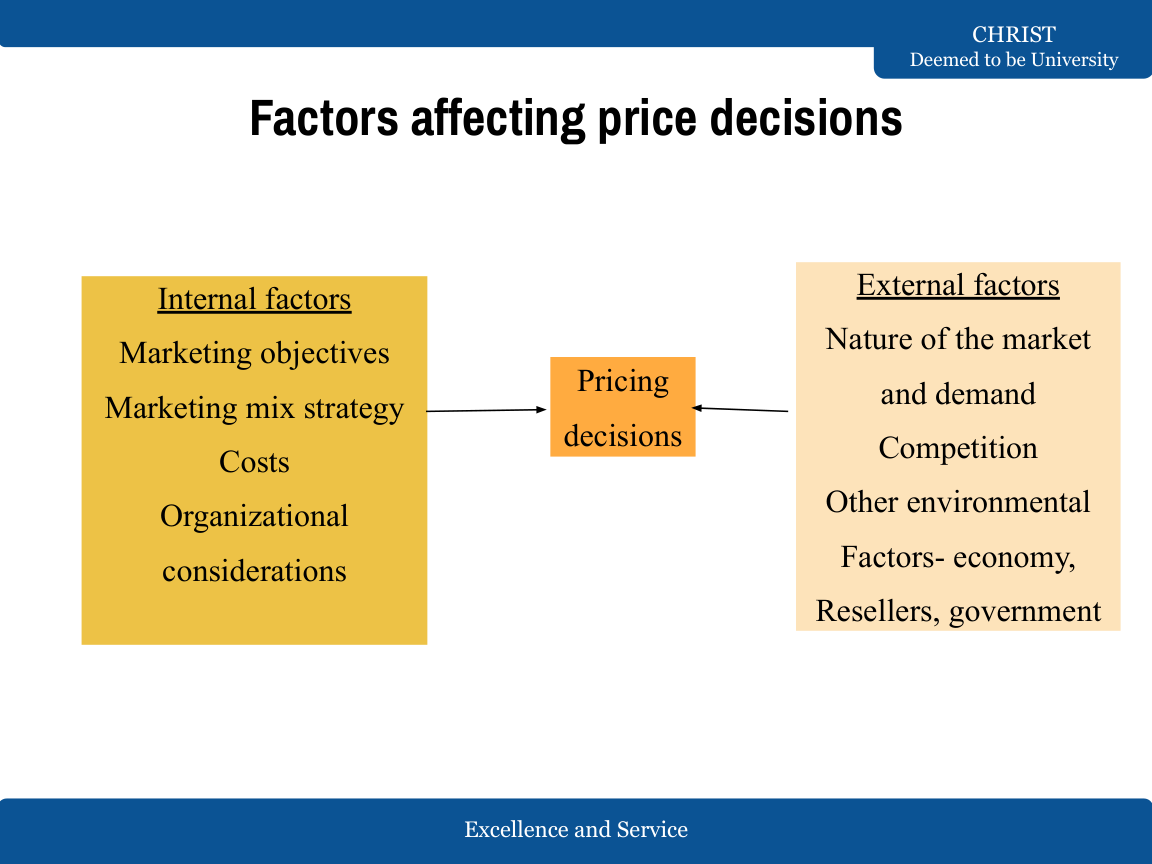
A business cannot choose a price by looking at costs alone. Internal factors include its goals, costs and marketing plan. External factors include demand, competitors, the economy and rules that affect prices.

In one sentence

Internal factors include marketing objectives, strategy, costs and organisational considerations. External factors include market demand, competition, the economy, resellers and government. An effective price reconciles these constraints rather than copying a competitor blindly.

Internal and external pricing factors
Original lecture diagram · PDF page 5. Internal and external pricing factors · Open page

Internal pricing factors

UNDERSTAND THE IDEA

Internal factors include marketing objectives, strategy, costs and organisational considerations. External factors include market demand, competition, the economy, resellers and government. An effective price reconciles these constraints rather than copying a competitor blindly. For internal pricing factors specifically, the important distinction is: these influences arise inside the business.

IN REAL LIFE

A bakery checks ingredient costs, target margin and overall marketing goals before setting cake prices. These influences arise inside the business.

Remember: These influences arise inside the business.

External pricing factors

UNDERSTAND THE IDEA

Internal factors include marketing objectives, strategy, costs and organisational considerations. External factors include market demand, competition, the economy, resellers and government. An effective price reconciles these constraints rather than copying a competitor blindly. For external pricing factors specifically, the important distinction is: these influences come from its market environment.

IN REAL LIFE

A bakery reviews local rivals, demand and tax changes before setting prices. These influences come from its market environment.

Remember: These influences come from its market environment.

See the original lecture slides and exact terminology

These extracts follow the lecturer’s slide order. Some original PDF lines are short fragments; select a slide number to see the complete original page.

  • Factors affecting price decisions
  • Internal factors
  • Marketing objectives
  • Marketing mix strategy
  • Organizational
  • considerations
  • External factors
  • Nature of the market
  • Other environmental
  • Factors- economy,
  • Resellers, government

Pricing objectives

Before setting a price, a business should know its main goal. It may want more profit, more sales, a larger market share or a stable position against competitors. The goal changes how prices are chosen.

In one sentence

Profit-oriented goals include target return and profit maximisation. Sales-oriented goals focus on volume or market share. Status quo objectives aim to stabilise prices or meet competitors. The choice affects how aggressively a company prices.

Profit-oriented pricing objectives

UNDERSTAND THE IDEA

Profit-oriented goals include target return and profit maximisation. Sales-oriented goals focus on volume or market share. Status quo objectives aim to stabilise prices or meet competitors. The choice affects how aggressively a company prices. For profit-oriented pricing objectives specifically, the important distinction is: the pricing goal centres on profit.

IN REAL LIFE

A shop calculates the margin needed to earn a target return on its equipment. The pricing goal centres on profit.

Remember: The pricing goal centres on profit.

Sales-oriented pricing objectives

UNDERSTAND THE IDEA

Profit-oriented goals include target return and profit maximisation. Sales-oriented goals focus on volume or market share. Status quo objectives aim to stabilise prices or meet competitors. The choice affects how aggressively a company prices. For sales-oriented pricing objectives specifically, the important distinction is: the immediate objective is volume or market share.

IN REAL LIFE

A cinema reduces weekday ticket prices to increase attendance. The immediate objective is volume or market share.

Remember: The immediate objective is volume or market share.

Status quo pricing objectives

UNDERSTAND THE IDEA

Profit-oriented goals include target return and profit maximisation. Sales-oriented goals focus on volume or market share. Status quo objectives aim to stabilise prices or meet competitors. The choice affects how aggressively a company prices. For status quo pricing objectives specifically, the important distinction is: its pricing aims to remain stable relative to competition.

IN REAL LIFE

A fuel station follows the going local price rather than triggering a price contest. Its pricing aims to remain stable relative to competition.

Remember: Its pricing aims to remain stable relative to competition.

See the original lecture slides and exact terminology

These extracts follow the lecturer’s slide order. Some original PDF lines are short fragments; select a slide number to see the complete original page.

  • Pricing Objectives: Profit-Oriented
  • Pricing Objectives: Sales-Oriented
  • Pricing Objectives: Status Quo
04 · Pricing Decisions

Demand, competition and price elasticity

Demand shows how much people want to buy at different prices. Price elasticity tells us how strongly demand changes when price changes. Businesses also look at competitors because customers compare alternatives.

In one sentence

Demand changes with price and other circumstances. Price elasticity expresses how responsive quantity demanded is to a price change. Competitive reactions matter because rivals can offset or amplify a pricing decision.

Market demand

UNDERSTAND THE IDEA

Demand changes with price and other circumstances. Price elasticity expresses how responsive quantity demanded is to a price change. Competitive reactions matter because rivals can offset or amplify a pricing decision. For market demand specifically, the important distinction is: customer demand responds to market conditions.

IN REAL LIFE

A restaurant notices that its lunchtime seats fill more quickly after price reductions. Customer demand responds to market conditions.

Remember: Customer demand responds to market conditions.

Competition and pricing

UNDERSTAND THE IDEA

Demand changes with price and other circumstances. Price elasticity expresses how responsive quantity demanded is to a price change. Competitive reactions matter because rivals can offset or amplify a pricing decision. For competition and pricing specifically, the important distinction is: competitive offers influence its price decision.

IN REAL LIFE

A stationery shop checks equivalent notebook prices in nearby stores. Competitive offers influence its price decision.

Remember: Competitive offers influence its price decision.

Price elasticity of demand

UNDERSTAND THE IDEA

Price elasticity describes how strongly the quantity bought changes when price changes. Demand is elastic if a small price change causes a large change in purchases. It is relatively inelastic if the quantity bought changes only a little.

IN REAL LIFE

A juice shop records how many bottles sell when its price rises slightly. The change in quantity demanded reveals responsiveness to price.

Remember: The change in quantity demanded reveals responsiveness to price.

See the original lecture slides and exact terminology

These extracts follow the lecturer’s slide order. Some original PDF lines are short fragments; select a slide number to see the complete original page.

  • Factors Influencing Price
  • Expected price
  • Demand curve
  • Price elasticity

Cost-plus and break-even pricing

Cost-plus pricing starts with the cost of making or selling something and adds a margin. Break-even pricing asks how many units must be sold before total revenue covers total cost. Both start with business costs.

In one sentence

Cost-plus pricing adds a markup to cost, but can overlook willingness to pay and competition. Break-even analysis compares total revenue with total cost and identifies volume at which costs are covered. Target-profit pricing adds a desired profit objective.

Cost-based pricing

UNDERSTAND THE IDEA

Cost-plus pricing adds a markup to cost, but can overlook willingness to pay and competition. Break-even analysis compares total revenue with total cost and identifies volume at which costs are covered. Target-profit pricing adds a desired profit objective. For cost-based pricing specifically, the important distinction is: the starting point is the cost of providing the offer.

IN REAL LIFE

A tailor lists fabric, labour and overhead costs before quoting for a uniform. The starting point is the cost of providing the offer.

Remember: The starting point is the cost of providing the offer.

Cost-plus pricing

UNDERSTAND THE IDEA

Cost-plus pricing starts with the cost of making or providing something, then adds an extra amount as profit. If a notebook costs ₹80 to produce and the seller adds ₹20, the price becomes ₹100.

IN REAL LIFE

A bakery calculates ₹60 cost per cake and adds a planned markup. Price is found by adding a margin to cost.

Remember: Price is found by adding a margin to cost.

Break-even analysis

UNDERSTAND THE IDEA

Cost-plus pricing adds a markup to cost, but can overlook willingness to pay and competition. Break-even analysis compares total revenue with total cost and identifies volume at which costs are covered. Target-profit pricing adds a desired profit objective. For break-even analysis specifically, the important distinction is: at the break-even quantity revenue equals total cost.

IN REAL LIFE

A café checks how many coffees it must sell before covering monthly rent and other costs. At the break-even quantity revenue equals total cost.

Remember: At the break-even quantity revenue equals total cost.

Target-profit pricing

UNDERSTAND THE IDEA

Cost-plus pricing adds a markup to cost, but can overlook willingness to pay and competition. Break-even analysis compares total revenue with total cost and identifies volume at which costs are covered. Target-profit pricing adds a desired profit objective. For target-profit pricing specifically, the important distinction is: its price is chosen with a planned profit objective.

IN REAL LIFE

A gym estimates the membership fee and volume needed to cover costs plus a target profit. Its price is chosen with a planned profit objective.

Remember: Its price is chosen with a planned profit objective.

See the original lecture slides and exact terminology

These extracts follow the lecturer’s slide order. Some original PDF lines are short fragments; select a slide number to see the complete original page.

  • General Pricing Approaches
  • Cost-Based Pricing: Cost-Plus Pricing
  • Adding a standard markup to cost
  • Ignores demand and competition
  • Popular pricing technique because:
  • It simplifies the pricing process
  • Price competition may be minimized
  • It is perceived as more fair to both buyers and sellers
  • Break-Even Analysis and Target Profit Pricing
  • Break-even charts show total cost and total
  • revenues at different levels of unit volume.
  • The intersection of the total revenue and total cost
  • curves is the break-even point.
  • Companies wishing to make a profit must exceed
  • the break-even unit volume.
06 · Pricing Decisions

Buyer value-based pricing

Value-based pricing starts with what customers believe a product is worth. A business studies the benefit the buyer expects and chooses a suitable price instead of simply adding a margin to cost.

In one sentence

Value-based pricing begins with the value buyers perceive, instead of only the seller’s production cost. It may support higher prices when benefits are meaningful and credible, though perceived value is difficult to measure.

Value-based pricing

UNDERSTAND THE IDEA

Value-based pricing sets the price primarily around the benefits customers believe they receive. Instead of beginning with manufacturing cost, the business asks how useful or valuable the solution feels to the buyer.

IN REAL LIFE

A train-ticket concierge service charges more for a genuine time-saving benefit. Its price reflects value buyers perceive, not only labour cost.

Remember: Its price reflects value buyers perceive, not only labour cost.

Buyer perceptions of value

UNDERSTAND THE IDEA

Value-based pricing begins with the value buyers perceive, instead of only the seller’s production cost. It may support higher prices when benefits are meaningful and credible, though perceived value is difficult to measure. For buyer perceptions of value specifically, the important distinction is: the same offering can be valued differently by customers.

IN REAL LIFE

One family happily pays extra for a durable schoolbag while another chooses the cheapest. The same offering can be valued differently by customers.

Remember: The same offering can be valued differently by customers.

See the original lecture slides and exact terminology

These extracts follow the lecturer’s slide order. Some original PDF lines are short fragments; select a slide number to see the complete original page.

  • Value-Based Pricing:
  • Uses buyers’ perceptions of value rather than seller’s
  • costs to set price.
  • Measuring perceived value can be difficult.
  • Consumer attitudes toward price and quality have shifted
  • during the last decade.
  • Introduction of less expensive versions of established
  • brands has become common.

Competition, bid and negotiated pricing

Competition-based pricing considers what other sellers charge. Some businesses also set prices through bidding or negotiation, especially when selling to organisations or working on contracts.

In one sentence

Going-rate pricing positions price around competitors. Bid pricing quotes a job-specific amount; negotiated pricing results from bargaining between parties. Cost knowledge remains vital when prices depend on competitive offers.

Competition-based pricing

UNDERSTAND THE IDEA

Going-rate pricing positions price around competitors. Bid pricing quotes a job-specific amount; negotiated pricing results from bargaining between parties. Cost knowledge remains vital when prices depend on competitive offers. For competition-based pricing specifically, the important distinction is: market rivals are a central reference point.

IN REAL LIFE

A local courier service sets delivery charges after studying equivalent regional courier offers. Market rivals are a central reference point.

Remember: Market rivals are a central reference point.

Bid pricing

UNDERSTAND THE IDEA

Going-rate pricing positions price around competitors. Bid pricing quotes a job-specific amount; negotiated pricing results from bargaining between parties. Cost knowledge remains vital when prices depend on competitive offers. For bid pricing specifically, the important distinction is: winning depends partly on competing bids and the tender criteria.

IN REAL LIFE

A contractor submits a sealed quotation for a government office maintenance tender. Winning depends partly on competing bids and the tender criteria.

Remember: Winning depends partly on competing bids and the tender criteria.

Negotiated pricing

UNDERSTAND THE IDEA

Going-rate pricing positions price around competitors. Bid pricing quotes a job-specific amount; negotiated pricing results from bargaining between parties. Cost knowledge remains vital when prices depend on competitive offers. For negotiated pricing specifically, the important distinction is: the price arises from negotiation.

IN REAL LIFE

A corporate hotel and its client agree on a room rate for recurring staff travel. The price arises from negotiation.

Remember: The price arises from negotiation.

See the original lecture slides and exact terminology

These extracts follow the lecturer’s slide order. Some original PDF lines are short fragments; select a slide number to see the complete original page.

  • Competition-Based Pricing
  • Also called going-rate pricing
  • May price at the same level, above, or below the
  • Bidding for jobs is another variation of
  • Sealed bid pricing
  • Bid pricing means offering a
  • specific price for each possible
  • job. Determining costs is a
  • complicated process.
  • Negotiated pricing involves
  • setting a price as the result of a
  • bargaining process between
  • the buyer and seller.
  • Bid and Negotiated Pricing

Skimming and penetration strategies

Price skimming means starting with a high launch price to reach buyers willing to pay more. Penetration pricing means starting relatively low to attract many buyers quickly. They work in different market situations.

In one sentence

Market skimming launches at a relatively high price to capture customers willing to pay more. Penetration pricing launches low to attract a broad customer base quickly. Suitability depends on demand, competitors, costs and the strategic objective.

INTERACTIVE EXPLANATIONChoose a strategy

Two opposite launch strategies

PriceTime →

Begin at a high price aimed at early buyers, then reduce it later to reach other customers.

Market-skimming pricing

UNDERSTAND THE IDEA

Skimming means launching a new product at a relatively high price to sell first to buyers willing to pay more. The price may be reduced later to reach a wider audience. It starts high.

IN REAL LIFE

A high-end smartphone launches at a premium aimed at enthusiastic first buyers. The company seeks greater return from customers willing to pay first.

Remember: The company seeks greater return from customers willing to pay first.

Market-penetration pricing

UNDERSTAND THE IDEA

Penetration pricing means introducing a product at a relatively low price to attract many buyers quickly and gain market share. It starts low, which is the opposite of market skimming.

IN REAL LIFE

A new coffee shop offers a low introductory price to encourage student trial. A lower price helps attract early market share.

Remember: A lower price helps attract early market share.

See the original lecture slides and exact terminology

These extracts follow the lecturer’s slide order. Some original PDF lines are short fragments; select a slide number to see the complete original page.

  • Pricing Strategies
  • New Product Pricing -Two major strategies
  • Market-Skimming Pricing
  • Setting a high price for a new product to
  • skim maximum revenues layer by layer from
  • segments willing to pay the high price.
  • Market-Penetration Pricing
  • Setting a low price for a new product in
  • order to attract a large number of buyers
  • and a large market share.

Product-mix pricing

When a business sells several related products, it can set their prices together. Examples include prices for different items in a line, optional extras, products needed together and bundles.

In one sentence

Product-line pricing establishes steps between versions. Optional-product pricing charges for add-ons; captive-product pricing involves necessary complements; by-product pricing recovers value from secondary outputs; bundle pricing combines items.

Product-line pricing

UNDERSTAND THE IDEA

Product-line pricing establishes steps between versions. Optional-product pricing charges for add-ons; captive-product pricing involves necessary complements; by-product pricing recovers value from secondary outputs; bundle pricing combines items. For product-line pricing specifically, the important distinction is: each price reflects a different level within the range.

IN REAL LIFE

A company sells basic, standard and premium headphones at stepped prices. Each price reflects a different level within the range.

Remember: Each price reflects a different level within the range.

Optional-product pricing

UNDERSTAND THE IDEA

Product-line pricing establishes steps between versions. Optional-product pricing charges for add-ons; captive-product pricing involves necessary complements; by-product pricing recovers value from secondary outputs; bundle pricing combines items. For optional-product pricing specifically, the important distinction is: the accessory adds to the main product price.

IN REAL LIFE

A car showroom charges separately for an optional upgraded sound system. The accessory adds to the main product price.

Remember: The accessory adds to the main product price.

Captive-product pricing

UNDERSTAND THE IDEA

Product-line pricing establishes steps between versions. Optional-product pricing charges for add-ons; captive-product pricing involves necessary complements; by-product pricing recovers value from secondary outputs; bundle pricing combines items. For captive-product pricing specifically, the important distinction is: the main product and necessary consumables are priced together strategically.

IN REAL LIFE

A printer is inexpensive, but buyers must regularly purchase compatible ink. The main product and necessary consumables are priced together strategically.

Remember: The main product and necessary consumables are priced together strategically.

By-product pricing

UNDERSTAND THE IDEA

Product-line pricing establishes steps between versions. Optional-product pricing charges for add-ons; captive-product pricing involves necessary complements; by-product pricing recovers value from secondary outputs; bundle pricing combines items. For by-product pricing specifically, the important distinction is: revenue from a lower-value by-product helps recover costs.

IN REAL LIFE

A sawmill sells wood offcuts to a local biomass producer. Revenue from a lower-value by-product helps recover costs.

Remember: Revenue from a lower-value by-product helps recover costs.

Product-bundle pricing

UNDERSTAND THE IDEA

Product-line pricing establishes steps between versions. Optional-product pricing charges for add-ons; captive-product pricing involves necessary complements; by-product pricing recovers value from secondary outputs; bundle pricing combines items. For product-bundle pricing specifically, the important distinction is: several products are offered together at a combined price.

IN REAL LIFE

A cinema sells one package containing a ticket, drink and popcorn. Several products are offered together at a combined price.

Remember: Several products are offered together at a combined price.

See the original lecture slides and exact terminology

These extracts follow the lecturer’s slide order. Some original PDF lines are short fragments; select a slide number to see the complete original page.

  • Product Mix Pricing Strategies
  • Product Line Pricing
  • Setting price steps between product line
  • Price points
  • Optional-Product Pricing
  • Pricing optional or accessory products sold
  • with the main product
  • Product Mix Pricing Strategies
  • Captive-Product Pricing
  • Pricing products that must be used with the
  • main product
  • High margins are often set for supplies
  • Services: two-part pricing strategy
  • Fixed fee plus a variable usage rate
  • Product Mix - Pricing Strategies
  • By-Product Pricing
  • Pricing low-value by-products to get rid of
  • Product Bundle Pricing
  • Pricing bundles of products sold together

Discount and allowance pricing

A discount reduces the normal selling price under certain conditions. An allowance is a reduction or benefit given for a particular action, such as trading in an old product or supporting a promotion.

In one sentence

Price adjustments can reward early payment, volume, trade functions or seasonal purchases. Allowances compensate for promotional support or exchanges. Firms must assess the effective realised price after reductions.

Cash discount

UNDERSTAND THE IDEA

Price adjustments can reward early payment, volume, trade functions or seasonal purchases. Allowances compensate for promotional support or exchanges. Firms must assess the effective realised price after reductions. For cash discount specifically, the important distinction is: the incentive rewards early payment.

IN REAL LIFE

A wholesaler offers a small discount when a retailer pays an invoice promptly. The incentive rewards early payment.

Remember: The incentive rewards early payment.

Quantity discount

UNDERSTAND THE IDEA

Price adjustments can reward early payment, volume, trade functions or seasonal purchases. Allowances compensate for promotional support or exchanges. Firms must assess the effective realised price after reductions. For quantity discount specifically, the important distinction is: larger purchase volume earns a price reduction.

IN REAL LIFE

A supplier quotes a lower unit price to a bookstore ordering 500 notebooks. Larger purchase volume earns a price reduction.

Remember: Larger purchase volume earns a price reduction.

Seasonal discount

UNDERSTAND THE IDEA

Price adjustments can reward early payment, volume, trade functions or seasonal purchases. Allowances compensate for promotional support or exchanges. Firms must assess the effective realised price after reductions. For seasonal discount specifically, the important distinction is: a seasonal price reduction stimulates demand.

IN REAL LIFE

A hotel offers lower room rates during its traditionally quiet season. A seasonal price reduction stimulates demand.

Remember: A seasonal price reduction stimulates demand.

Trade discount

UNDERSTAND THE IDEA

Price adjustments can reward early payment, volume, trade functions or seasonal purchases. Allowances compensate for promotional support or exchanges. Firms must assess the effective realised price after reductions. For trade discount specifically, the important distinction is: the allowance recognises intermediary functions.

IN REAL LIFE

A manufacturer gives authorised dealers a reduction from the list price. The allowance recognises intermediary functions.

Remember: The allowance recognises intermediary functions.

Allowances

UNDERSTAND THE IDEA

Price adjustments can reward early payment, volume, trade functions or seasonal purchases. Allowances compensate for promotional support or exchanges. Firms must assess the effective realised price after reductions. For allowances specifically, the important distinction is: the transaction uses a price allowance.

IN REAL LIFE

A phone dealer discounts a new device when a customer trades in an eligible older model. The transaction uses a price allowance.

Remember: The transaction uses a price allowance.

See the original lecture slides and exact terminology

These extracts follow the lecturer’s slide order. Some original PDF lines are short fragments; select a slide number to see the complete original page.

  • Price Adjustment Strategies
  • Discount / allowance
  • Psychological
  • Geographical
  • International
  • 1. Discount / allowance
  • Types of discounts
  • Cash discount
  • Quantity discount
  • Functional (trade) discount
  • Seasonal discount
  • Trade-in allowances
  • Promotional allowances
11 · Pricing Decisions

Segmented pricing

Segmented pricing means charging different prices to different customer groups, times, locations or product versions when that difference is not simply the result of cost.

In one sentence

Segmented pricing charges differing prices for customer groups, product forms, locations or times when differences are not solely explained by cost. Segments must be appropriately identified and price rules communicated fairly.

Segmented pricing

UNDERSTAND THE IDEA

Segmented pricing charges differing prices for customer groups, product forms, locations or times when differences are not solely explained by cost. Segments must be appropriately identified and price rules communicated fairly. For segmented pricing specifically, the important distinction is: the price differs by customer segment.

IN REAL LIFE

A museum provides different stated entry rates for students and standard visitors. The price differs by customer segment.

Remember: The price differs by customer segment.

Customer-segment pricing

UNDERSTAND THE IDEA

Segmented pricing charges differing prices for customer groups, product forms, locations or times when differences are not solely explained by cost. Segments must be appropriately identified and price rules communicated fairly. For customer-segment pricing specifically, the important distinction is: two customer groups pay different prices for access.

IN REAL LIFE

A theatre offers a student price on proof of a valid student card. Two customer groups pay different prices for access.

Remember: Two customer groups pay different prices for access.

Location-based pricing

UNDERSTAND THE IDEA

Segmented pricing charges differing prices for customer groups, product forms, locations or times when differences are not solely explained by cost. Segments must be appropriately identified and price rules communicated fairly. For location-based pricing specifically, the important distinction is: the specific location changes the perceived value and price.

IN REAL LIFE

A concert hall charges different amounts for front-row and upper-tier seats. The specific location changes the perceived value and price.

Remember: The specific location changes the perceived value and price.

See the original lecture slides and exact terminology

These extracts follow the lecturer’s slide order. Some original PDF lines are short fragments; select a slide number to see the complete original page.

  • 2. Segmented- Pricing
  • Customer-pricing
  • Product-form pricing
  • Location pricing
  • Time pricing

Psychological and promotional pricing

Psychological pricing considers how a price feels to customers. Promotional pricing is a temporary offer designed to encourage purchases. Both affect customer response, but in different ways.

In one sentence

Psychological pricing uses how consumers interpret numbers, quality cues and reference prices. Promotional pricing makes temporary changes such as rebates or special event discounts. Both should avoid misleading consumers.

Psychological pricing

UNDERSTAND THE IDEA

Psychological pricing uses how consumers interpret numbers, quality cues and reference prices. Promotional pricing makes temporary changes such as rebates or special event discounts. Both should avoid misleading consumers. For psychological pricing specifically, the important distinction is: the presentation of price can affect buyer perception.

IN REAL LIFE

A retailer prices a T-shirt at ₹999 rather than ₹1,000. The presentation of price can affect buyer perception.

Remember: The presentation of price can affect buyer perception.

Promotional pricing

UNDERSTAND THE IDEA

Psychological pricing uses how consumers interpret numbers, quality cues and reference prices. Promotional pricing makes temporary changes such as rebates or special event discounts. Both should avoid misleading consumers. For promotional pricing specifically, the important distinction is: the temporary incentive is designed to generate short-term demand.

IN REAL LIFE

A shop offers a legitimate weekend reduction for a selected product. The temporary incentive is designed to generate short-term demand.

Remember: The temporary incentive is designed to generate short-term demand.

See the original lecture slides and exact terminology

These extracts follow the lecturer’s slide order. Some original PDF lines are short fragments; select a slide number to see the complete original page.

  • 3. Psychological
  • Price conveys something about the product
  • Price-quality relationships
  • Numeric digits may have psychological influence
  • 4. Promotional
  • Temporarily pricing below list price
  • Cash rebates
  • Special event pricing
  • Low interest financing
13 · Pricing Decisions

Geographical and international pricing

Where a customer lives can affect what they pay because shipping costs differ. The lecture names methods such as FOB-origin, uniform-delivered and zone pricing. Selling internationally may also involve different currencies, taxes and delivery costs; those details are extra explanations.

In one sentence

The lecture identifies FOB-origin, uniform-delivered and zone pricing. International pricing and price-change strategies are named in its overview but not substantively developed; supplementary considerations include exchange rates, freight, tax and legal constraints.

Geographical pricing

UNDERSTAND THE IDEA

The lecture identifies FOB-origin, uniform-delivered and zone pricing. International pricing and price-change strategies are named in its overview but not substantively developed; supplementary considerations include exchange rates, freight, tax and legal constraints. For geographical pricing specifically, the important distinction is: delivery location affects the final selling price.

IN REAL LIFE

A furniture maker adds transport charges for customers in distant districts. Delivery location affects the final selling price.

Remember: Delivery location affects the final selling price.

International pricing

UNDERSTAND THE IDEA

The lecture identifies FOB-origin, uniform-delivered and zone pricing. International pricing and price-change strategies are named in its overview but not substantively developed; supplementary considerations include exchange rates, freight, tax and legal constraints. For international pricing specifically, the important distinction is: the same product may need different market-specific prices.

IN REAL LIFE

A phone company reviews exchange rates and local taxes when pricing in two countries. The same product may need different market-specific prices.

Remember: The same product may need different market-specific prices.

Price changes

UNDERSTAND THE IDEA

The lecture identifies FOB-origin, uniform-delivered and zone pricing. International pricing and price-change strategies are named in its overview but not substantively developed; supplementary considerations include exchange rates, freight, tax and legal constraints. For price changes specifically, the important distinction is: management must weigh business costs against likely customer reactions.

IN REAL LIFE

A bakery prepares to revise cake prices after a major rise in butter costs. Management must weigh business costs against likely customer reactions.

Remember: Management must weigh business costs against likely customer reactions.

See the original lecture slides and exact terminology

These extracts follow the lecturer’s slide order. Some original PDF lines are short fragments; select a slide number to see the complete original page.

  • 5. Geographical
  • FOB origin pricing
  • Uniform delivered pricing
  • Zone pricing
Complete chapter index
Source-backed coverage

Coverage & original slides

All 13 teaching sections in this chapter group are listed below. Original lecture slides are linked within each section so you can verify important terms, diagrams and lists.

Source material

These are notes based on the uploaded Marketing Management lecture PDFs. Examples added to explain a concept are illustrative, not quotations from the lecturer.

Uploaded source documents

Complete teaching index

YOU HAVE REACHED THE END OF THIS CHAPTER

Next chapter · 04

Distribution
YOUR PRIVATE NOTES

Saved passages.

Passages are saved on this device. Export a copy if you may change devices.

ORIGINAL LECTURE PDF

Source slide

Check the original lecturer material without leaving your notes.

Open PDF in a new tab ↗