VARSHA BABYMARKETING · PERSONAL EDITIONOVERALL0%
0% read
Mind Map
UNIT V · Simple English · Complete PDF study notes

Competitive Dynamics & Responsible Marketing

See how firms compete, protect their positions and market products with social and environmental responsibility. Every section follows the supplied lecture material, with a clear meaning, useful examples and slide references.

Select a chapter above. Scroll down to read the notes in order.
YOUR PERSONAL READING EDITION

Varsha Baby is 0% complete.

Across all six chaptersThis chapter · 0%

Based on how far you've read. Saved automatically on this device.

What this chapter contains

Made for understanding the material from the beginning, not just memorising headings.

Lecture PDF pages19
Study sections9
Important concepts36
01 · Competitive Dynamics & Responsible Marketing

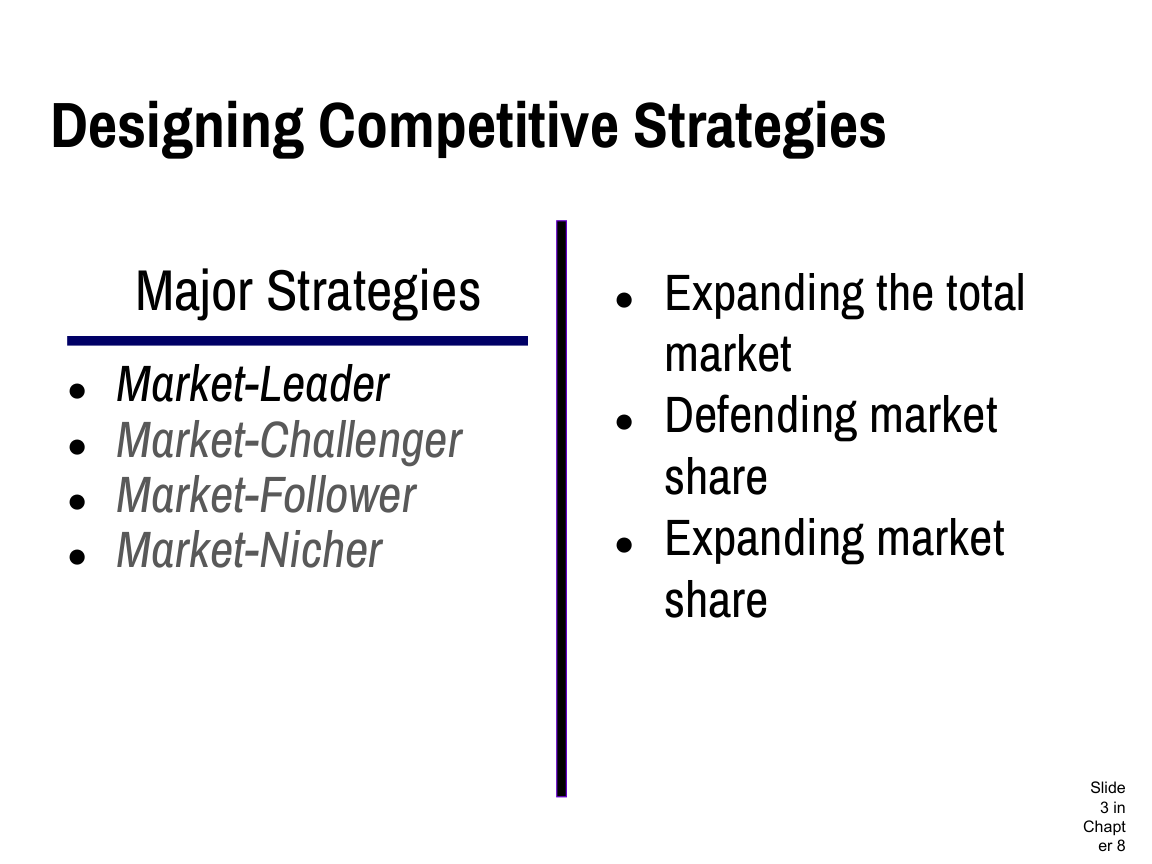
Four competitive positions

Market leader, challenger, follower and nicher
Original lecture diagram · PDF page 3. Market leader, challenger, follower and nicher · Open page

Market leader strategy

UNDERSTAND THE IDEA

A market leader usually has the largest share within its market. It tries to increase overall demand, protect its existing position and, where worthwhile, grow its share further.

IN REAL LIFE

The largest neighbourhood supermarket improves stock availability and loyalty rewards to retain buyers. The firm tries to protect and expand its leading position.

Market challenger strategy

UNDERSTAND THE IDEA

A market challenger is a strong competitor trying to gain share from larger rivals. It may attack their main offering directly, serve neglected customer groups or enter less contested markets.

IN REAL LIFE

A smaller grocery chain targets customers whose neighbourhood has limited fresh-food options. The challenger attacks an unmet need rather than copying every rival offer.

Market follower strategy

UNDERSTAND THE IDEA

A market follower competes without directly challenging the leader for dominance. It may adapt proven ideas and focus on efficiency or an attractive customer group.

IN REAL LIFE

A minor detergent producer adopts common pack sizes and industry-standard selling practices. It avoids direct confrontation with the largest brands.

Market nicher strategy

UNDERSTAND THE IDEA

A market nicher concentrates on a smaller, specialised group whose needs are not fully served by large competitors. Its advantage comes from understanding that group unusually well.

IN REAL LIFE

A small retailer specialises entirely in equipment for long-distance cyclists. Deep expertise serves a narrow audience.

See the original lecture slides and exact terminology

Original PDF page links are supplied for verification. Some slides use diagrams or split their sentences across lines; the linked PDF is authoritative.

  • View this page in the original lecturer PDF (includes its exact text and diagrams).
  • View this page in the original lecturer PDF (includes its exact text and diagrams).
02 · Competitive Dynamics & Responsible Marketing

Expanding the total market

Expand total market

UNDERSTAND THE IDEA

Expanding the total market means increasing overall demand for the product category. The leader may reach new users, encourage new uses or increase frequency of consumption.

IN REAL LIFE

A tea producer encourages new groups to try tea and suggests additional occasions to consume it. Growth comes from total category demand rather than only stealing a rival's customers.

Find new users

UNDERSTAND THE IDEA

Finding new users means attracting people who do not currently buy the product. A business may target another age group, region or situation where the offering is useful.

IN REAL LIFE

A breakfast-cereal brand introduces simple recipe ideas to reach adults who previously thought cereal was only for children. The brand identifies a new group of possible buyers.

Promote new product uses

UNDERSTAND THE IDEA

Promoting new uses teaches existing or new customers additional practical ways to use the product. It can increase value and demand without changing the core item.

IN REAL LIFE

A baking-soda company explains safe household cleaning uses in addition to cooking. New applications can expand demand.

Encourage greater product use

UNDERSTAND THE IDEA

Encouraging greater use means increasing how often or how much existing customers appropriately consume. Responsible marketers should avoid encouraging harmful or wasteful use.

IN REAL LIFE

A toothpaste brand explains appropriate twice-daily brushing in a dental-health campaign. Regular use may increase category consumption when the guidance is accurate.

See the original lecture slides and exact terminology

Original PDF page links are supplied for verification. Some slides use diagrams or split their sentences across lines; the linked PDF is authoritative.

  • View this page in the original lecturer PDF (includes its exact text and diagrams).
03 · Competitive Dynamics & Responsible Marketing

Challenger attack strategies

INTERACTIVE EXPLANATIONCompare the approach

Three ways to challenge a rival

Frontal attackFlank attackBypass attack

Compete directly against the rival in its strongest market, often comparing the same core offering.

Frontal attack

UNDERSTAND THE IDEA

A frontal attack competes against a rival on its main strengths, such as price, quality or distribution. It can be costly because the competitor is already strong in those areas.

IN REAL LIFE

A challenger matches the market leader's core features and competes directly on the main offer. It meets the rival on familiar competitive ground.

Flank attack

UNDERSTAND THE IDEA

A flank attack targets a customer need, segment or location that a larger rival serves poorly. It avoids fighting on the strongest part of the rival's business.

IN REAL LIFE

A challenger opens branches in smaller towns that the largest chain serves poorly. The attack focuses on an under-served market area.

Bypass attack

UNDERSTAND THE IDEA

A bypass attack avoids direct confrontation by moving into new markets, technologies or product categories. The business grows where the rival may have less presence.

IN REAL LIFE

A small technology firm enters a new service category rather than attacking the incumbent in its strongest product. It reaches a different opportunity without a direct battle.

Price discount attack

UNDERSTAND THE IDEA

A price discount attack tries to attract rival customers with a cheaper offer. It succeeds only if customers still believe quality and service are acceptable.

IN REAL LIFE

A new retailer introduces a lower price for a comparable item for a defined period. Price is used to challenge established rivals.

Product innovation attack

UNDERSTAND THE IDEA

A product innovation attack competes by offering a meaningful improvement or new feature. The change must matter to customers, not merely look different.

IN REAL LIFE

A challenger introduces a genuinely improved product feature absent from the leader's current model. The new benefit becomes its competitive move.

Distribution innovation attack

UNDERSTAND THE IDEA

Distribution innovation competes by making products easier or faster to access. A new delivery channel can reach buyers that rivals overlook.

IN REAL LIFE

A brand allows reliable pickup from local collection points where rivals require home delivery. A new channel improves convenience for a defined group.

See the original lecture slides and exact terminology

Original PDF page links are supplied for verification. Some slides use diagrams or split their sentences across lines; the linked PDF is authoritative.

  • View this page in the original lecturer PDF (includes its exact text and diagrams).
  • View this page in the original lecturer PDF (includes its exact text and diagrams).
  • View this page in the original lecturer PDF (includes its exact text and diagrams).
04 · Competitive Dynamics & Responsible Marketing

Follower strategies

Counterfeiter follower

UNDERSTAND THE IDEA

A counterfeiter copies a rival's branding or products and presents them as genuine. Counterfeiting is deceptive and can violate intellectual-property laws.

IN REAL LIFE

A seller illegally copies another brand's protected marks and packaging. Imitating the actual brand identity is not a legitimate follower strategy.

Cloner follower

UNDERSTAND THE IDEA

A cloner closely imitates a leading product's appearance or approach while selling under its own identity. Customers may see little differentiation.

IN REAL LIFE

A rival copies the basic appearance and marketing pattern of a leading brand. Its similarity makes it difficult to distinguish without close examination.

Imitator follower

UNDERSTAND THE IDEA

An imitator follows some successful features of a leader but keeps noticeable differences. It borrows broad ideas without producing an identical offering.

IN REAL LIFE

A small business follows popular product formats while keeping its own branding and selected differences. It copies broad successful practices but is not identical.

Adapter follower

UNDERSTAND THE IDEA

An adapter takes a leader's successful concept and changes or improves it for another market or need. Adaptation can become a distinct competitive approach.

IN REAL LIFE

A regional shop adopts the general format of a leading chain and improves it for local buyers. The model is adapted to a particular market.

See the original lecture slides and exact terminology

Original PDF page links are supplied for verification. Some slides use diagrams or split their sentences across lines; the linked PDF is authoritative.

  • View this page in the original lecturer PDF (includes its exact text and diagrams).
05 · Competitive Dynamics & Responsible Marketing

Market nicher specialisations

End-user specialisation

UNDERSTAND THE IDEA

An end-user specialist designs its offer for a particular type of customer. Deep knowledge of that group's tasks can make its solution especially useful.

IN REAL LIFE

An equipment firm serves only professional dental clinics. It develops expertise in one end-user category.

Vertical-level specialisation

UNDERSTAND THE IDEA

A vertical-level specialist focuses on one stage in an industry's supply chain. It may serve producers, distributors or retailers with specialised expertise.

IN REAL LIFE

A supplier concentrates on serving wholesalers rather than both retailers and final consumers. It focuses on one level of the value chain.

Geographic specialisation

UNDERSTAND THE IDEA

A geographic specialist concentrates on one region or local market. Local familiarity helps tailor stock, service and distribution.

IN REAL LIFE

A small delivery company focuses on dependable service across one hilly district. Location defines its narrow specialisation.

Product-line specialisation

UNDERSTAND THE IDEA

A product-line specialist offers a narrow set of related products in depth. It builds knowledge and variety within that category rather than serving everyone.

IN REAL LIFE

A retailer stocks only premium mechanical keyboards and related parts. A product category defines the niche.

Customer-size specialisation

UNDERSTAND THE IDEA

Customer-size specialisation serves businesses of a particular scale, such as small shops or large institutions. Needs and purchasing processes can vary with size.

IN REAL LIFE

A software service designs its sales and support around micro-businesses with fewer than ten staff. The customer organisation's size defines the niche.

See the original lecture slides and exact terminology

Original PDF page links are supplied for verification. Some slides use diagrams or split their sentences across lines; the linked PDF is authoritative.

  • View this page in the original lecturer PDF (includes its exact text and diagrams).
06 · Competitive Dynamics & Responsible Marketing

Sustainable marketing

Sustainable marketing

UNDERSTAND THE IDEA

Sustainable marketing means serving customers today while considering the long-term wellbeing of customers, society and the environment. Short-term sales are not enough if marketing practices cause avoidable harm.

IN REAL LIFE

A clothing shop begins repairing worn items and reducing unnecessary packaging. The business considers longer-term resources and customer wellbeing.

Consumerism

UNDERSTAND THE IDEA

Consumerism is the movement advocating stronger protection of buyers' rights and interests. It calls attention to product safety, truthful information and fair treatment.

IN REAL LIFE

Customers organise to demand clear ingredient labels and transparent refund policies. Consumer interests receive collective protection and attention.

Environmentalism

UNDERSTAND THE IDEA

Environmentalism focuses on protecting the natural environment from harmful economic activity. Marketers consider materials, packaging, resource use and disposal.

IN REAL LIFE

A residents' group asks a packaging company to reduce litter and single-use plastic. Its concern is the effect of business activity on the environment.

Societal marketing principles

UNDERSTAND THE IDEA

Societal marketing aims to balance customer satisfaction, business objectives and the community's long-term well-being. It asks whether an attractive offer is also responsible.

IN REAL LIFE

A food company weighs affordability, nutrition and its own viability before launching a product. Business success is considered alongside customer and societal wellbeing.

Responsible marketing actions

UNDERSTAND THE IDEA

Responsible marketing includes truthful claims, safe products, fair pricing and reducing unnecessary environmental harm. Public promises should be supported by actual business practices.

IN REAL LIFE

A cosmetics brand checks product claims, materials and complaint procedures before running a campaign. Responsibility becomes a measurable operating practice.

See the original lecture slides and exact terminology

Original PDF page links are supplied for verification. Some slides use diagrams or split their sentences across lines; the linked PDF is authoritative.

  • View this page in the original lecturer PDF (includes its exact text and diagrams).
  • View this page in the original lecturer PDF (includes its exact text and diagrams).
  • View this page in the original lecturer PDF (includes its exact text and diagrams).
  • View this page in the original lecturer PDF (includes its exact text and diagrams).
07 · Competitive Dynamics & Responsible Marketing

Social criticisms of marketing

Social criticisms of marketing

UNDERSTAND THE IDEA

Social criticism examines where marketing practices may harm customers, society or other businesses. Examples include misleading claims, unnecessary waste and unfair competition.

IN REAL LIFE

A campaign is criticised for exaggerating performance and pressuring vulnerable customers. The criticism questions the effects of marketing practice.

Marketing impact on individuals

UNDERSTAND THE IDEA

Marketing can affect individuals through information, prices, product quality and persuasion. Criticism focuses on risks such as deception, intrusive selling and unsafe products.

IN REAL LIFE

A customer spends more than intended after seeing misleading urgency claims in an advertisement. The concern focuses on effects on individual buyers.

Marketing impact on society

UNDERSTAND THE IDEA

Marketing can influence society's consumption habits, cultural values, resources and environment. Responsible practice considers effects beyond one transaction.

IN REAL LIFE

A city experiences more packaging waste as disposable products are heavily promoted. The concern extends beyond any one purchaser.

Marketing impact on other businesses

UNDERSTAND THE IDEA

Marketing actions can harm other businesses when firms use deceptive, unfair or exclusionary practices. Competition should reward better value rather than manipulation.

IN REAL LIFE

A dominant supplier imposes restrictive distribution terms on smaller rivals. The issue concerns fairness and competition between firms.

See the original lecture slides and exact terminology

Original PDF page links are supplied for verification. Some slides use diagrams or split their sentences across lines; the linked PDF is authoritative.

  • View this page in the original lecturer PDF (includes its exact text and diagrams).
08 · Competitive Dynamics & Responsible Marketing

Ethical marketing principles

Marketing ethics

UNDERSTAND THE IDEA

Marketing ethics means making honest, fair and responsible decisions when promoting and selling products. It includes truthful claims, respect for customers and avoiding misleading or harmful practices.

IN REAL LIFE

A sales team declines to use an advertisement containing a claim it cannot substantiate. Honesty guides the marketing decision.

Ethical marketing practice

UNDERSTAND THE IDEA

Ethical practice means making truthful claims, respecting consumer privacy and avoiding unfair pressure. It should guide everyday decisions, not just publicity campaigns.

IN REAL LIFE

A retailer posts complete warranty conditions and correct prices before taking payment. Customers receive information needed for a fair decision.

Consumer protection

UNDERSTAND THE IDEA

Consumer protection involves safeguards against unsafe goods, misleading information and unfair business behaviour. Clear terms and meaningful complaint procedures support buyer trust.

IN REAL LIFE

A buyer receives a defective appliance and the seller honours the stated remedy process. Clear obligations protect customers in transactions.

See the original lecture slides and exact terminology

Original PDF page links are supplied for verification. Some slides use diagrams or split their sentences across lines; the linked PDF is authoritative.

  • View this page in the original lecturer PDF (includes its exact text and diagrams).
  • View this page in the original lecturer PDF (includes its exact text and diagrams).
09 · Competitive Dynamics & Responsible Marketing

Closing synthesis

Competitive strategy and social responsibility synthesis

UNDERSTAND THE IDEA

A competitive strategy should create value while respecting customers, competitors and wider society. Short-term growth can damage the business if it relies on harm or deception.

IN REAL LIFE

A retailer expands its reach while keeping truthful advertising and responsible waste management. Growth and ethical conduct are treated as connected strategic considerations.

Complete chapter index
Source-backed coverage

Coverage & original slides

All 9 teaching sections in this chapter group are listed below. Original lecture slides are linked within each section so you can verify important terms, diagrams and lists.

Source material

These are notes based on the uploaded Marketing Management lecture PDFs. Examples added to explain a concept are illustrative, not quotations from the lecturer.

Uploaded source documents

Complete teaching index

YOU HAVE REACHED THE END OF THIS CHAPTER

Return to chapter 01

Marketing Foundations
YOUR PRIVATE NOTES

Saved passages.

Passages are saved on this device. Export a copy if you may change devices.

ORIGINAL LECTURE PDF

Source slide

Check the original lecturer material without leaving your notes.

Open PDF in a new tab ↗

Find your place.

Choose any lesson. You can also type a topic name to filter the list.