VARSHA BABYMARKETING · PERSONAL EDITIONOVERALL0%
0% read
Mind Map
UNIT IV · Simple English · Complete PDF study notes

Promotion

Understand how businesses communicate with customers through advertising, promotion, selling and public relations. Every section follows the supplied lecture material, with a clear meaning, useful examples and slide references.

Select a chapter above. Scroll down to read the notes in order.
YOUR PERSONAL READING EDITION

Varsha Baby is 0% complete.

Across all six chaptersThis chapter · 0%

Based on how far you've read. Saved automatically on this device.

What this chapter contains

Made for understanding the material from the beginning, not just memorising headings.

Lecture PDF pages23
Study sections11
Important concepts44

Promotion mix: five tools

Advertising

UNDERSTAND THE IDEA

Advertising is a paid message from an identifiable sponsor used to inform or persuade an audience about a product, service or idea. Television commercials and sponsored online ads are examples.

IN REAL LIFE

A bookshop pays for a newspaper placement announcing a new branch. A clearly identified sponsor buys non-personal promotional space.
Direct marketing

UNDERSTAND THE IDEA

Direct marketing communicates directly with selected customers to invite a response. A personalised promotional email or catalogue sent to a customer is a familiar example.

IN REAL LIFE

A furniture business mails a relevant product catalogue to customers who requested updates. The message is aimed at specific prospective buyers.

Sales promotion

UNDERSTAND THE IDEA

Sales promotion is a short-term incentive intended to encourage people to try or buy something. Examples include limited-time coupons, free samples and special purchase offers.

IN REAL LIFE

A grocery chain offers a genuine limited-time coupon for a newly launched cereal. The short-term incentive encourages trial.

Public relations and publicity

UNDERSTAND THE IDEA

Public relations manages relationships and reputation with different audiences. Publicity is attention obtained through media coverage or public discussion, rather than simply buying an advertising slot.

IN REAL LIFE

A factory explains its safety procedures during a community meeting and responds to media questions. Public communication helps manage relationships and reputation.

Personal selling

UNDERSTAND THE IDEA

Personal selling involves direct communication between a salesperson and a potential buyer. It allows questions, explanations and individual persuasion, which can matter for complicated purchases.

IN REAL LIFE

A sales adviser demonstrates a sewing machine and answers a buyer's specific questions. Two-way personal interaction supports the sale.

See the original lecture slides and exact terminology

Original PDF page links are supplied for verification. Some slides use diagrams or split their sentences across lines; the linked PDF is authoritative.

  • View this page in the original lecturer PDF (includes its exact text and diagrams).

Communication process and AIDA

INTERACTIVE EXPLANATIONFollow the customer

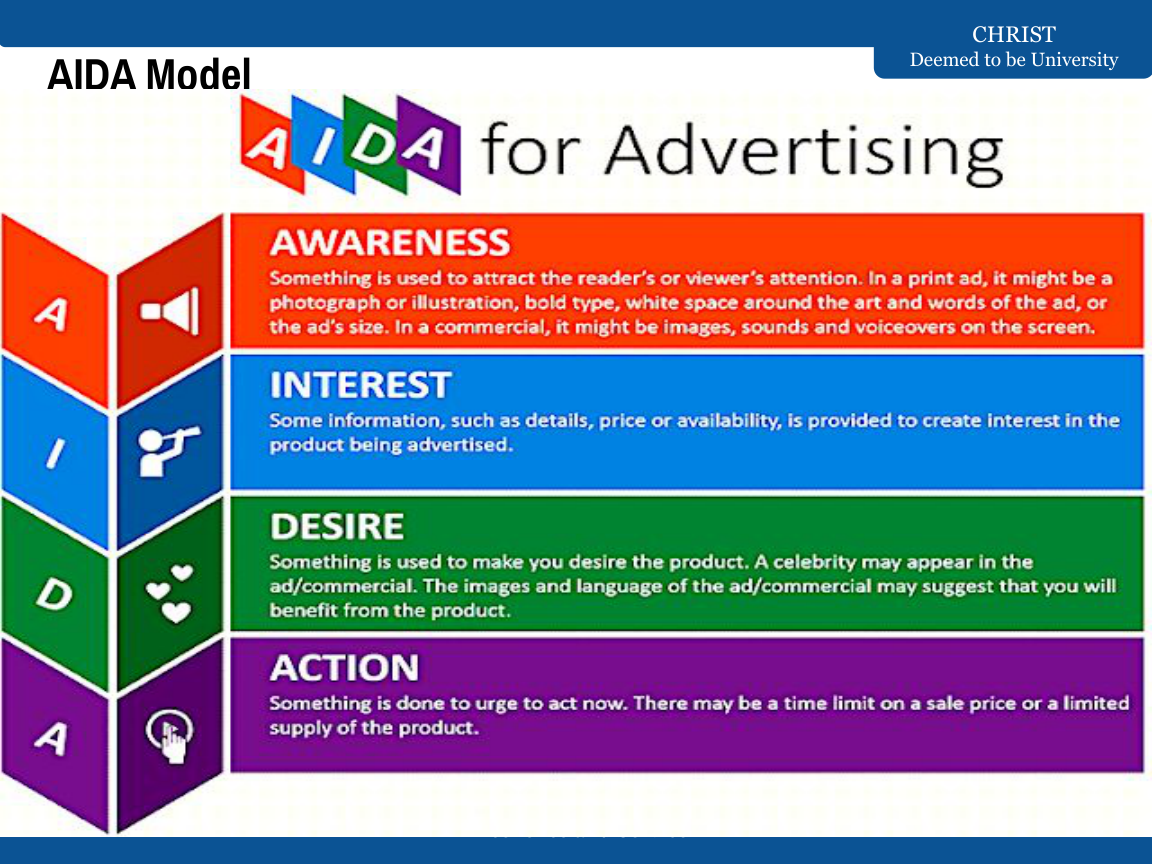
AIDA: from attention to action

AwarenessInterestDesireAction

The customer notices the product for the first time.

AIDA: attention, interest, desire and action
Original lecture diagram · PDF page 4. AIDA: attention, interest, desire and action · Open page

Sender and receiver

UNDERSTAND THE IDEA

In marketing communication, the sender creates and delivers a message while the receiver interprets it. The two may understand the same message differently.

IN REAL LIFE

A restaurant sends an opening announcement to nearby residents. The business originates the message and residents receive it.

Encoding and decoding

UNDERSTAND THE IDEA

Encoding is turning an idea into words, images or symbols. Decoding is how the audience interprets those signals, so unclear language can cause misunderstandings.

IN REAL LIFE

A phone brand uses an icon to communicate battery life, but some customers read it as a signal-strength claim. The company encodes a meaning that buyers may decode differently.

Feedback and response

UNDERSTAND THE IDEA

A response is the receiver's reaction to a message; feedback is information returning to the sender. Marketers use feedback to judge whether communication worked.

IN REAL LIFE

After sending a new menu, a café reads customers' replies and adjusts its communication. The response returns useful information to the original sender.

AIDA awareness

UNDERSTAND THE IDEA

Awareness is the first AIDA stage. The customer must notice or discover the product before they can become interested in it. An eye-catching advertisement may begin this stage.

IN REAL LIFE

A bright but truthful street poster introduces a previously unknown bakery. The first task is to make prospective buyers notice the name.

AIDA interest

UNDERSTAND THE IDEA

Interest is the second AIDA stage. Once someone notices the product, they start paying attention to useful details such as features, suitability or price.

IN REAL LIFE

A curious customer reads the bakery's menu and opening hours after seeing the poster. Practical information holds the buyer's attention.

AIDA desire

UNDERSTAND THE IDEA

Desire is the stage when the buyer starts wanting the product personally. The message connects product benefits to the customer’s own situation or goal.

IN REAL LIFE

A bakery shows clear images of freshly prepared goods and highlights the benefits customers value. Interest develops into a preference or desire.

AIDA action

UNDERSTAND THE IDEA

Action is the final AIDA stage, when the person takes the intended step, such as buying the product, booking a trial or making an enquiry.

IN REAL LIFE

The bakery places a clear location and booking link beside its advertised offer. The communication makes the next purchasing step obvious.

See the original lecture slides and exact terminology

Original PDF page links are supplied for verification. Some slides use diagrams or split their sentences across lines; the linked PDF is authoritative.

  • View this page in the original lecturer PDF (includes its exact text and diagrams).

Developing effective communication

Identify target audience

UNDERSTAND THE IDEA

Before preparing a message, marketers define who they want to reach and what those people already know. The target audience shapes language, channels and examples.

IN REAL LIFE

A tutoring company decides its course advert should address final-year law students rather than every college student. Audience choice guides the message and channel.

Communication objectives

UNDERSTAND THE IDEA

Communication objectives specify the desired result of a campaign, such as awareness, understanding or purchase intention. An objective should guide what message is created.

IN REAL LIFE

A small clinic decides that its first campaign should explain available treatments before asking people to book. The intended audience response is defined in advance.

Message design

UNDERSTAND THE IDEA

Message design decides what to say and how to express it clearly and persuasively. A useful message connects a real customer need with a believable benefit.

IN REAL LIFE

A safety-equipment firm explains the risks its certified helmets are designed to reduce. It chooses content and wording that fit the buyer's concern.

Communication channel choice

UNDERSTAND THE IDEA

Channel choice determines where the message reaches its intended audience. Personal channels allow interaction; mass media and digital channels can reach many people.

IN REAL LIFE

A local language bookshop compares print notices and social media to reach older and younger customers. The delivery medium needs to match the audience.

See the original lecture slides and exact terminology

Original PDF page links are supplied for verification. Some slides use diagrams or split their sentences across lines; the linked PDF is authoritative.

  • View this page in the original lecturer PDF (includes its exact text and diagrams).
  • View this page in the original lecturer PDF (includes its exact text and diagrams).

Promotion budgeting methods

Affordable promotion budget method

UNDERSTAND THE IDEA

The affordable method sets the promotion budget at what the business believes it can spend. It is simple but may underfund effective communication.

IN REAL LIFE

A bakery sets its promotion spending to what remains after essential operating costs. The budget is determined by perceived affordability rather than stated objectives.

Percentage-of-sales method

UNDERSTAND THE IDEA

The percentage-of-sales method allocates a fixed proportion of current or expected sales to promotion. It is easy to apply but ties spending to sales rather than specific needs.

IN REAL LIFE

A shop allocates a fixed share of expected sales revenue to promotion. The budget rises and falls with the sales base.

Competitive parity method

UNDERSTAND THE IDEA

Competitive parity uses rival spending levels as a reference for setting the promotion budget. Competitors' budgets may not match the company's own goals.

IN REAL LIFE

A retailer studies how much nearby rivals spend on advertising before setting its own budget. Competitor expenditure becomes the reference point.

Objective-and-task method

UNDERSTAND THE IDEA

The objective-and-task method estimates the cost of the actions required to achieve defined promotion objectives. It starts with the intended outcome rather than an arbitrary budget.

IN REAL LIFE

A company defines a goal of reaching 5,000 local buyers, lists the required activities and costs them. The budget follows specified objectives and tasks.

See the original lecture slides and exact terminology

Original PDF page links are supplied for verification. Some slides use diagrams or split their sentences across lines; the linked PDF is authoritative.

  • View this page in the original lecturer PDF (includes its exact text and diagrams).

Promotion mix decisions and IMC

Push strategy

UNDERSTAND THE IDEA

A push strategy promotes products through retailers, distributors and salespeople so they encourage customers to buy. It focuses effort on channel members.

IN REAL LIFE

A soap manufacturer trains distributors and offers trade display support. The immediate effort persuades intermediaries to stock and recommend the brand.

Pull strategy

UNDERSTAND THE IDEA

A pull strategy creates demand among final customers so they ask retailers for the product. Consumer advertising can help pull products through distribution channels.

IN REAL LIFE

Consumers ask their local shop for a shampoo after seeing a useful advertisement. End-user demand encourages retailers to request the product.

Integrated marketing communications

UNDERSTAND THE IDEA

Integrated marketing communications makes advertising, personal selling, promotions and other channels communicate a consistent message. Customers should not receive contradictory claims.

IN REAL LIFE

A brand uses consistent benefits, contact information and pricing across print, online and retail signage. Different channels communicate one coherent message.

See the original lecture slides and exact terminology

Original PDF page links are supplied for verification. Some slides use diagrams or split their sentences across lines; the linked PDF is authoritative.

  • View this page in the original lecturer PDF (includes its exact text and diagrams).
  • View this page in the original lecturer PDF (includes its exact text and diagrams).

Advertising planning, message and media

Advertising objective

UNDERSTAND THE IDEA

An advertising objective defines what a paid campaign should achieve, such as informing, persuading or reminding customers. Clear objectives guide creative work and evaluation.

IN REAL LIFE

A water-filter brand aims first to explain how its product works, not to claim instant market leadership. The objective determines what the advert should achieve.

Advertising budget

UNDERSTAND THE IDEA

An advertising budget is the amount set aside for creating and placing paid messages. It should reflect objectives, available funds and expected reach.

IN REAL LIFE

A company estimates what it can reasonably spend to reach a specific audience through selected media. The budget supports the communication plan.

Advertising message

UNDERSTAND THE IDEA

The advertising message is the key idea a sponsor wants customers to understand. It needs an understandable promise, relevant evidence and suitable execution.

IN REAL LIFE

An air-purifier advert explains filter replacement and tested features rather than using only a slogan. The message carries the meaningful product promise.

Media planning

UNDERSTAND THE IDEA

Media planning selects platforms, timing and placement for advertising. Reach, frequency, audience habits and cost help determine the best combination.

IN REAL LIFE

A college bookstore chooses campus posters and search results over television advertising. It places media where likely customers actually look.

Advertising evaluation

UNDERSTAND THE IDEA

Advertising evaluation checks whether the campaign reached the intended audience and influenced awareness or behaviour. Results help decide what to change next time.

IN REAL LIFE

A café compares customer awareness before and after a small local campaign. It checks communication results rather than assuming the ad worked.

See the original lecture slides and exact terminology

Original PDF page links are supplied for verification. Some slides use diagrams or split their sentences across lines; the linked PDF is authoritative.

  • View this page in the original lecturer PDF (includes its exact text and diagrams).
  • View this page in the original lecturer PDF (includes its exact text and diagrams).
  • View this page in the original lecturer PDF (includes its exact text and diagrams).
  • View this page in the original lecturer PDF (includes its exact text and diagrams).

Sales promotion and its tools

Consumer sales promotion

UNDERSTAND THE IDEA

Consumer sales promotion gives buyers short-term reasons to try or buy a product, such as samples or coupons. It aims at the final consumer.

IN REAL LIFE

A supermarket gives shoppers a limited-time free sample of a new drink. The incentive is aimed at final buyers.

Trade sales promotion

UNDERSTAND THE IDEA

Trade sales promotion offers incentives to retailers or distributors to stock, display or recommend a product. Its audience is the channel member rather than the end buyer.

IN REAL LIFE

A packaged-food producer offers retailers a display allowance for a new product. The incentive is directed to the distribution channel.

Sales promotion tools

UNDERSTAND THE IDEA

Promotional tools include samples, coupons, price offers, contests, displays and dealer incentives. Different tools suit different audiences and campaign objectives.

IN REAL LIFE

A brand chooses samples, coupons and contests based on what each tool can achieve. Different short-term incentives suit different objectives.

See the original lecture slides and exact terminology

Original PDF page links are supplied for verification. Some slides use diagrams or split their sentences across lines; the linked PDF is authoritative.

  • View this page in the original lecturer PDF (includes its exact text and diagrams).
  • View this page in the original lecturer PDF (includes its exact text and diagrams).

Public relations and publicity

Public relations

UNDERSTAND THE IDEA

Public relations builds and protects an organisation's relationships and reputation with stakeholders. It may use media communication, events and community programmes.

IN REAL LIFE

A company holds a factual briefing after neighbours raise pollution concerns. It engages stakeholders through explanation and dialogue.

Publicity

UNDERSTAND THE IDEA

Publicity is attention an organisation or product receives through news coverage or other public discussion. It differs from a standard purchased advertising placement.

IN REAL LIFE

A local newspaper independently reports a restaurant's community meal programme. The media mention is not a paid advertisement placed by the restaurant.

Public relations tools

UNDERSTAND THE IDEA

PR tools can include press releases, interviews, events, publications and community activities. They communicate information and help manage public understanding.

IN REAL LIFE

A company combines a press release, an open house and public information materials. Different activities address stakeholders' information needs.

See the original lecture slides and exact terminology

Original PDF page links are supplied for verification. Some slides use diagrams or split their sentences across lines; the linked PDF is authoritative.

  • View this page in the original lecturer PDF (includes its exact text and diagrams).

Direct, online marketing and personal selling

Direct mail

UNDERSTAND THE IDEA

Direct mail sends promotional material directly to selected people or organisations. It can be targeted but must avoid unwanted or misleading messages.

IN REAL LIFE

A college bookshop posts an examination-guide catalogue to subscribers who asked for it. A specific customer list receives information directly.

Catalogue marketing

UNDERSTAND THE IDEA

Catalogue marketing presents a collection of products so customers can browse and order. Catalogues may be printed or digital.

IN REAL LIFE

A wholesale supplier sends businesses an organised illustrated list of products and prices. The catalogue allows buyers to choose from a complete offer.

Telemarketing

UNDERSTAND THE IDEA

Telemarketing uses telephone conversations to inform customers or seek purchases. It depends on respectful consent, appropriate timing and clear information.

IN REAL LIFE

A bank representative calls customers who agreed to hear about a new service. The telephone becomes the direct communication channel.

Digital marketing channels

UNDERSTAND THE IDEA

Digital channels include websites, search, email and social platforms used to reach and interact with customers. Each channel serves different customer behaviours.

IN REAL LIFE

A small firm compares email, search and social media to inform likely buyers. Different web channels reach different moments in the customer journey.

Personal selling process

UNDERSTAND THE IDEA

Personal selling involves identifying prospects, learning their needs, presenting a suitable offer, handling concerns and following up. It relies on two-way interaction.

IN REAL LIFE

A sales adviser learns a buyer's needs, demonstrates options, handles questions and closes a suitable sale. Selling involves steps rather than one persuasive sentence.

Sales management

UNDERSTAND THE IDEA

Sales management plans, supports and evaluates the sales team. Recruitment, training, targets and feedback help salespeople perform responsibly.

IN REAL LIFE

A manager trains and reviews the performance of a sales team using clear service standards. Supervision supports consistent selling behaviour.

See the original lecture slides and exact terminology

Original PDF page links are supplied for verification. Some slides use diagrams or split their sentences across lines; the linked PDF is authoritative.

  • View this page in the original lecturer PDF (includes its exact text and diagrams).
  • View this page in the original lecturer PDF (includes its exact text and diagrams).
  • View this page in the original lecturer PDF (includes its exact text and diagrams).

Multilevel marketing

Multilevel marketing

UNDERSTAND THE IDEA

Multilevel marketing uses a network of individual sellers who may earn compensation from their own sales and, under some plans, a team's sales. Its structure requires careful scrutiny.

IN REAL LIFE

A company sells products through independent participants who may also recruit other sellers. Its sales model depends on the actual product and compensation structure.

Ethical concerns in multilevel marketing

UNDERSTAND THE IDEA

Ethical concerns arise if recruiting people becomes more important than genuine retail demand or earnings claims are misleading. Participants need transparent costs, risks and compensation information.

IN REAL LIFE

A recruitment pitch places heavy emphasis on enrolment fees but gives little evidence of genuine product demand. Prospective participants should distinguish real sales from misleading recruitment claims.

See the original lecture slides and exact terminology

Original PDF page links are supplied for verification. Some slides use diagrams or split their sentences across lines; the linked PDF is authoritative.

  • View this page in the original lecturer PDF (includes its exact text and diagrams).

Why IMC matters and AI in promotion

Benefits of integrated marketing communications

UNDERSTAND THE IDEA

Consistent marketing communications make an offer easier to recognise and understand across channels. Coordination can reduce conflicting messages and wasted effort.

IN REAL LIFE

A customer hears the same clear pricing and product details from a shop's website and its salesperson. Consistency reduces confusion and supports trust.

AI in promotion

UNDERSTAND THE IDEA

AI tools can support drafting, audience analysis and testing promotional ideas. Marketers must still check accuracy, consent, fairness and whether the final message is truthful.

IN REAL LIFE

A small brand uses software to suggest advert drafts, then checks claims and audience suitability before publishing. Automation assists creative work but still requires human verification.

See the original lecture slides and exact terminology

Original PDF page links are supplied for verification. Some slides use diagrams or split their sentences across lines; the linked PDF is authoritative.

  • View this page in the original lecturer PDF (includes its exact text and diagrams).
  • View this page in the original lecturer PDF (includes its exact text and diagrams).
Complete chapter index
Source-backed coverage

Coverage & original slides

All 11 teaching sections in this chapter group are listed below. Original lecture slides are linked within each section so you can verify important terms, diagrams and lists.

Source material

These are notes based on the uploaded Marketing Management lecture PDFs. Examples added to explain a concept are illustrative, not quotations from the lecturer.

Uploaded source documents

Complete teaching index

YOU HAVE REACHED THE END OF THIS CHAPTER

Next chapter · 06

Competition + Ethics
YOUR PRIVATE NOTES

Saved passages.

Passages are saved on this device. Export a copy if you may change devices.

ORIGINAL LECTURE PDF

Source slide

Check the original lecturer material without leaving your notes.

Open PDF in a new tab ↗

Find your place.

Choose any lesson. You can also type a topic name to filter the list.