VARSHA BABYMARKETING · PERSONAL EDITIONOVERALL0%
0% read
Mind Map
UNIT III · Simple English · Complete PDF study notes

Distribution Strategy

Follow how a product moves from the producer to the customer, including channel members, retailing and logistics. Every section follows the supplied lecture material, with a clear meaning, useful examples and slide references.

Select a chapter above. Scroll down to read the notes in order.
YOUR PERSONAL READING EDITION

Varsha Baby is 0% complete.

Across all six chaptersThis chapter · 0%

Based on how far you've read. Saved automatically on this device.

What this chapter contains

Made for understanding the material from the beginning, not just memorising headings.

Lecture PDF pages31
Study sections10
Important concepts37

Value delivery networks, channels and intermediaries

Value delivery networks

UNDERSTAND THE IDEA

A value delivery network is the set of businesses working together to get value to the customer. The producer, suppliers, delivery partners, retailers and customer each play a part in making the final offer work.

IN REAL LIFE

A vegetable seller works with growers, transport operators, retailers and customers. Better coordination reduces delays across the full network.
Marketing channels

UNDERSTAND THE IDEA

A marketing channel is the path through which a product reaches the final customer. It may go directly from producer to buyer or pass through retailers, wholesalers and other intermediaries.

IN REAL LIFE

A soap manufacturer chooses whether to sell directly online or through supermarkets. Each option moves the product to consumers through a different sequence of organisations.

Merchant middlemen

UNDERSTAND THE IDEA

A merchant intermediary buys goods and takes ownership before reselling them. A wholesaler buying stock for resale is different from an agent who only arranges a deal.

IN REAL LIFE

A local wholesaler buys cartons of snacks and then resells them to smaller stores. It takes ownership of the stock before selling it.

Functional middlemen

UNDERSTAND THE IDEA

Functional intermediaries help products move or ownership transfer but do not normally own the goods. Brokers and agents may arrange transactions for others.

IN REAL LIFE

A sales agent introduces a ceramic producer to hotel buyers but never owns the tiles. The intermediary helps arrange the sale without taking title.

Wholesalers

UNDERSTAND THE IDEA

Wholesalers mainly sell products to other businesses such as retailers, rather than to final consumers. They often buy in larger quantities and help move goods efficiently through the channel.

IN REAL LIFE

A wholesaler sells large boxes of pens to multiple bookshops. The buyer is usually another business rather than a final user.

Retailers

UNDERSTAND THE IDEA

Retailers are businesses that sell goods or services directly to final consumers for their personal use. A neighbourhood supermarket is a retailer even if it buys its stock from a wholesaler.

IN REAL LIFE

A campus stationery shop sells individual notebooks to students. The retailer serves the final consumer.

Channel member functions

UNDERSTAND THE IDEA

Channel members help by gathering information, promoting offers, contacting buyers, matching stock, negotiating, distributing, financing and taking risks. These functions make buying more convenient.

IN REAL LIFE

A distributor stores goods, contacts shops, handles transport and negotiates supply. Intermediaries perform several functions beyond simply carrying products.

See the original lecture slides and exact terminology

Original PDF page links are supplied for verification. Some slides use diagrams or split their sentences across lines; the linked PDF is authoritative.

  • View this page in the original lecturer PDF (includes its exact text and diagrams).
  • View this page in the original lecturer PDF (includes its exact text and diagrams).
  • View this page in the original lecturer PDF (includes its exact text and diagrams).
  • View this page in the original lecturer PDF (includes its exact text and diagrams).

Channels for consumer goods

INTERACTIVE EXPLANATIONChoose a distribution path

How a product reaches the customer

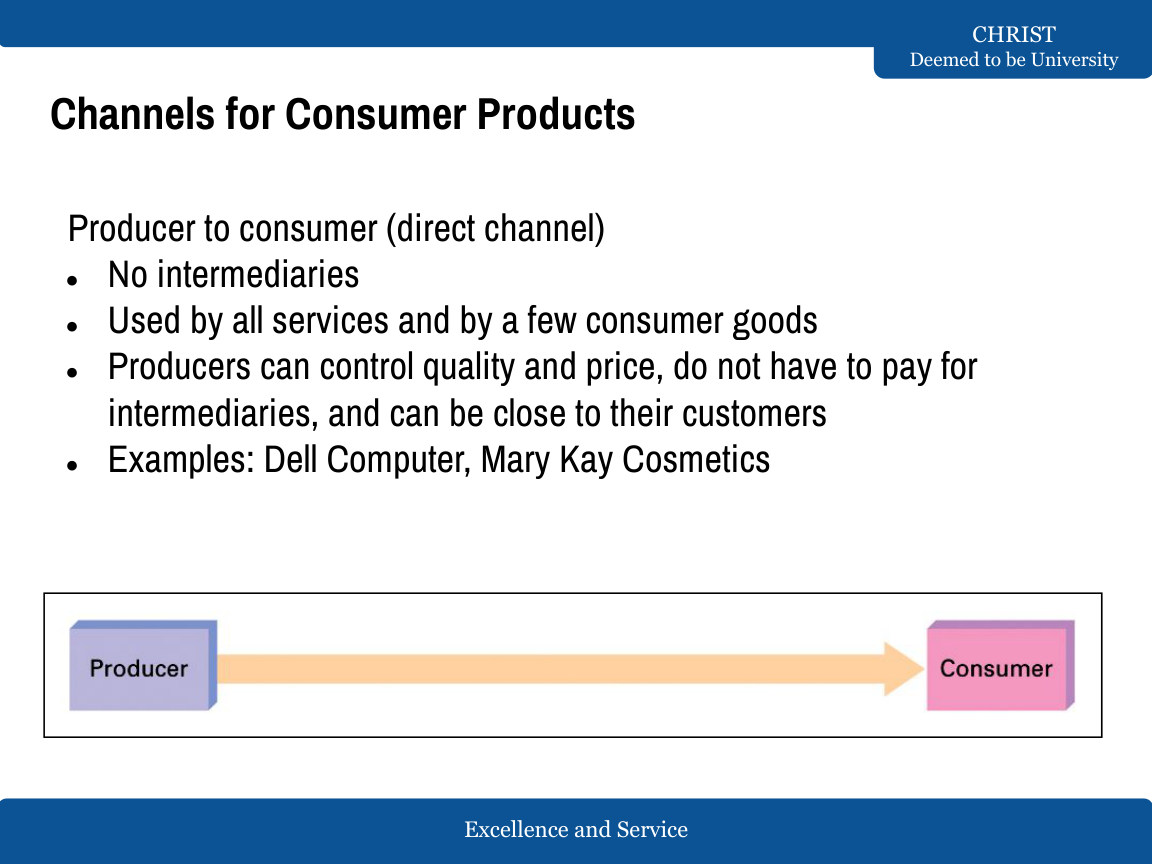
Producer → Consumer

The producer sells straight to the customer without an intermediary.

Direct distribution channel
Original lecture diagram · PDF page 6. Direct distribution channel · Open page

Direct consumer channel

UNDERSTAND THE IDEA

A direct channel moves from producer straight to final consumer with no intermediary. It gives the producer more contact with customers but makes the producer manage distribution itself.

IN REAL LIFE

A farmer sells fresh produce to households from a stall she operates herself. No independent wholesaler or retailer is inserted between producer and consumer.

Retailer channel

UNDERSTAND THE IDEA

A retailer channel runs from producer to retailer to consumer. The retailer makes products available for customers to inspect and buy locally.

IN REAL LIFE

A manufacturer supplies packaged bread to a supermarket, which sells it to families. The retailer is the main intermediary before the final buyer.

Wholesaler retailer channel

UNDERSTAND THE IDEA

A wholesaler-retailer channel adds a wholesaler between producer and retailer. Wholesalers combine supply from producers and help smaller shops purchase suitable quantities.

IN REAL LIFE

A snack maker supplies a wholesaler, who delivers cartons to small shops serving consumers. Two different intermediary levels take part.

Agent wholesaler channel

UNDERSTAND THE IDEA

An agent-based route includes someone who arranges distribution or sales without typically owning the product. Additional channel levels may expand reach but also add coordination needs.

IN REAL LIFE

A textile exporter uses an agent to locate a wholesaler, who resells cloth to retailers. The agent connects buyers while the wholesaler handles purchased inventory.

Multilevel distribution

UNDERSTAND THE IDEA

A multilevel channel passes through several intermediaries before reaching the final buyer. Each level can increase market coverage but also affects control, cost and communication.

IN REAL LIFE

A regional goods producer uses an agent, distributor and retailer network to reach remote customers. More intermediary levels extend geographic coverage but add coordination.

See the original lecture slides and exact terminology

Original PDF page links are supplied for verification. Some slides use diagrams or split their sentences across lines; the linked PDF is authoritative.

  • View this page in the original lecturer PDF (includes its exact text and diagrams).
  • View this page in the original lecturer PDF (includes its exact text and diagrams).
  • View this page in the original lecturer PDF (includes its exact text and diagrams).
  • View this page in the original lecturer PDF (includes its exact text and diagrams).
  • View this page in the original lecturer PDF (includes its exact text and diagrams).

Business product channels

Direct business channel

UNDERSTAND THE IDEA

In a direct business channel, a producer sells straight to another organisation. It works well when orders are large, technical or need close supplier support.

IN REAL LIFE

An industrial pump maker contracts directly with a factory for equipment and maintenance. The producer serves the organisational user without a reseller.

Indirect business channel

UNDERSTAND THE IDEA

An indirect business channel uses distributors or other intermediaries to reach organisational customers. It can improve coverage when the producer cannot serve every buyer directly.

IN REAL LIFE

A machine-tool manufacturer supplies a specialist industrial distributor who sells to workshops. The distributor links producer and business customer.

See the original lecture slides and exact terminology

Original PDF page links are supplied for verification. Some slides use diagrams or split their sentences across lines; the linked PDF is authoritative.

  • View this page in the original lecturer PDF (includes its exact text and diagrams).
  • View this page in the original lecturer PDF (includes its exact text and diagrams).

Intensity of distribution

Intensive distribution

UNDERSTAND THE IDEA

Intensive distribution places a product in as many suitable outlets as possible. It is common for items people expect to buy quickly, such as snacks.

IN REAL LIFE

A biscuit brand supplies nearly every suitable grocery and convenience shop in an area. Broad availability is the main channel objective.

Selective distribution

UNDERSTAND THE IDEA

Selective distribution uses a chosen number of outlets instead of every available retailer. The producer balances coverage with the quality of selling and service.

IN REAL LIFE

An appliance maker appoints trained electronics retailers in each district. It balances market reach with dealer expertise.

Exclusive distribution

UNDERSTAND THE IDEA

Exclusive distribution gives very limited outlets the right to sell a product in an area. It can support close control and a specialised brand image.

IN REAL LIFE

A luxury watch brand authorises a single dealer in the city. Very limited coverage protects a carefully controlled distribution position.

Market coverage

UNDERSTAND THE IDEA

Market coverage describes how widely a product is available to customers. The chosen coverage should fit how often and where buyers expect to shop.

IN REAL LIFE

A drinks company maps how many target customers can actually buy its bottles near work or home. Coverage measures practical availability rather than advertising reach.

See the original lecture slides and exact terminology

Original PDF page links are supplied for verification. Some slides use diagrams or split their sentences across lines; the linked PDF is authoritative.

  • View this page in the original lecturer PDF (includes its exact text and diagrams).
  • View this page in the original lecturer PDF (includes its exact text and diagrams).
  • View this page in the original lecturer PDF (includes its exact text and diagrams).

Vertical Marketing Systems

Vertical marketing system

UNDERSTAND THE IDEA

A vertical marketing system coordinates producers, wholesalers and retailers as a connected channel. Members work together rather than acting entirely independently.

IN REAL LIFE

A manufacturer and its distribution partners agree on common stock standards and promotional plans. Channel levels act as a coordinated system.

Corporate VMS

UNDERSTAND THE IDEA

In a corporate vertical system, one company owns more than one level of the distribution channel. Ownership helps it coordinate production and selling decisions directly.

IN REAL LIFE

A clothing business owns its manufacturing facility and retail outlets. Common ownership coordinates production and selling.

Contractual VMS

UNDERSTAND THE IDEA

A contractual vertical system coordinates independent businesses through agreements. Franchise organisations are one example of coordinated but separately owned operations.

IN REAL LIFE

Independent restaurant franchisees follow agreed standards under a common brand contract. Formal agreements hold the system together.

Administered VMS

UNDERSTAND THE IDEA

In an administered vertical system, a powerful channel member coordinates others because of influence rather than ownership or contracts. Large retailers may shape suppliers' practices.

IN REAL LIFE

A powerful supermarket chain sets display requirements that suppliers follow to remain on its shelves. Influence, rather than common ownership, coordinates activities.

See the original lecture slides and exact terminology

Original PDF page links are supplied for verification. Some slides use diagrams or split their sentences across lines; the linked PDF is authoritative.

  • View this page in the original lecturer PDF (includes its exact text and diagrams).
  • View this page in the original lecturer PDF (includes its exact text and diagrams).
  • View this page in the original lecturer PDF (includes its exact text and diagrams).
  • View this page in the original lecturer PDF (includes its exact text and diagrams).
  • View this page in the original lecturer PDF (includes its exact text and diagrams).

Channel selection and design

Channel design

UNDERSTAND THE IDEA

Channel design decides the path a product should follow to reach customers. Firms consider customer needs, desired coverage, costs, control and available intermediaries.

IN REAL LIFE

A packaged-food producer compares direct orders, supermarkets and regional distributors before launch. It chooses a channel structure suitable for product and customer needs.

Channel member selection

UNDERSTAND THE IDEA

Selecting channel members means choosing distributors or retailers that can represent and deliver the product well. Location, reliability and capabilities are key considerations.

IN REAL LIFE

A manufacturer interviews distributors about storage quality, financing and delivery reliability. The producer chooses intermediaries against clear requirements.

Channel member evaluation

UNDERSTAND THE IDEA

Channel evaluation reviews whether intermediaries meet expected sales, service and distribution standards. Regular assessment reveals where support or changes are needed.

IN REAL LIFE

A dairy company audits how reliably each distributor delivers fresh products on time. Channel performance is reviewed after appointment.

Economic and control criteria

UNDERSTAND THE IDEA

Economic criteria compare costs and expected returns from different channel choices. Control criteria examine how much influence the producer keeps over sales and customer experience.

IN REAL LIFE

A brand compares two delivery routes on cost, market access and its ability to maintain standards. Channel choice involves economic trade-offs and control.

See the original lecture slides and exact terminology

Original PDF page links are supplied for verification. Some slides use diagrams or split their sentences across lines; the linked PDF is authoritative.

  • View this page in the original lecturer PDF (includes its exact text and diagrams).
  • View this page in the original lecturer PDF (includes its exact text and diagrams).
  • View this page in the original lecturer PDF (includes its exact text and diagrams).
  • View this page in the original lecturer PDF (includes its exact text and diagrams).
07 · Distribution Strategy

Channel conflict and behaviour

Horizontal channel conflict

UNDERSTAND THE IDEA

Horizontal conflict occurs between intermediaries at the same channel level, such as two retailers. Disputes may concern prices, territory or customers.

IN REAL LIFE

Two shops carrying the same authorised brand complain that one is selling in the other's assigned territory. The dispute occurs between members at the same channel level.

Vertical channel conflict

UNDERSTAND THE IDEA

Vertical conflict occurs between different levels, such as a producer and retailer. Problems can arise over promotions, delivery, margins or responsibilities.

IN REAL LIFE

A manufacturer starts undercutting its own authorised retailers through direct online discounts. The conflict occurs between different channel levels.

Channel cooperation

UNDERSTAND THE IDEA

Channel cooperation means partners coordinate efforts so the whole channel performs better. Shared information, clear expectations and fair incentives reduce unnecessary conflict.

IN REAL LIFE

A producer shares realistic delivery forecasts with retailers before a festival. Coordination can reduce stock-outs and misunderstanding.

See the original lecture slides and exact terminology

Original PDF page links are supplied for verification. Some slides use diagrams or split their sentences across lines; the linked PDF is authoritative.

  • View this page in the original lecturer PDF (includes its exact text and diagrams).

Retailing, wholesaling and channel management

Retailing

UNDERSTAND THE IDEA

Retailing includes activities involved in selling goods or services directly to final consumers for personal use. It can happen in shops, on websites or through other formats.

IN REAL LIFE

A neighbourhood store arranges shelves, opening hours and payment facilities for final shoppers. Retail decisions determine the customer-facing purchase experience.

Wholesaling

UNDERSTAND THE IDEA

Wholesaling sells goods or services primarily to organisations that will resell or use them for business purposes. It supports bulk movement and stock availability.

IN REAL LIFE

A rice wholesaler aggregates sacks from several producers and supplies restaurants. The wholesaler purchases or handles goods for trade buyers.

Channel member management

UNDERSTAND THE IDEA

Channel management involves supporting, motivating and monitoring channel partners after selecting them. A channel needs ongoing coordination rather than a one-time contract.

IN REAL LIFE

A paint manufacturer trains dealers and reviews stock availability each month. Appointed channel partners need ongoing support and evaluation.

See the original lecture slides and exact terminology

Original PDF page links are supplied for verification. Some slides use diagrams or split their sentences across lines; the linked PDF is authoritative.

  • View this page in the original lecturer PDF (includes its exact text and diagrams).
  • View this page in the original lecturer PDF (includes its exact text and diagrams).
09 · Distribution Strategy

Omnichannel and emerging formats

Omnichannel distribution

UNDERSTAND THE IDEA

Omnichannel distribution connects multiple selling channels so customers can move smoothly between them. A buyer might order online and collect the product from a store.

IN REAL LIFE

A clothing customer checks availability online, reserves an item and collects it from a store. Connected channels provide one buying journey.

Dropshipping

UNDERSTAND THE IDEA

Dropshipping lets a seller take an order while a separate supplier ships the goods directly to the buyer. The seller may avoid storing inventory but must still manage customer expectations.

IN REAL LIFE

An online seller takes an order, and a separate supplier ships the item to the buyer. The seller may not hold the physical stock.

Subscription distribution

UNDERSTAND THE IDEA

Subscription distribution delivers an offering repeatedly under a recurring arrangement. Regular schedules can simplify replenishment when customers need the same product often.

IN REAL LIFE

A household arranges monthly delivery of regular groceries. Predictable recurring orders replace repeated individual purchases.

Dark stores and micro fulfilment

UNDERSTAND THE IDEA

Dark stores are facilities used to fulfil online orders rather than welcome walk-in shoppers. Micro-fulfilment centres are smaller locations designed to prepare nearby deliveries quickly.

IN REAL LIFE

A local grocery service picks digital orders from a small delivery-only inventory location. The facility serves online fulfilment rather than walk-in shoppers.

See the original lecture slides and exact terminology

Original PDF page links are supplied for verification. Some slides use diagrams or split their sentences across lines; the linked PDF is authoritative.

  • View this page in the original lecturer PDF (includes its exact text and diagrams).
10 · Distribution Strategy

Mushroom distribution case study

Mushroom distribution case study

UNDERSTAND THE IDEA

A distribution case study follows how a producer can move perishable mushrooms to customers while keeping quality and delivery time under control. Evaluate storage, intermediaries and local demand.

IN REAL LIFE

A mushroom producer worries about spoilage when selling to distant shops. Channel timing and handling become central because the product is perishable.

See the original lecture slides and exact terminology

Original PDF page links are supplied for verification. Some slides use diagrams or split their sentences across lines; the linked PDF is authoritative.

  • View this page in the original lecturer PDF (includes its exact text and diagrams).
Complete chapter index
Source-backed coverage

Coverage & original slides

All 10 teaching sections in this chapter group are listed below. Original lecture slides are linked within each section so you can verify important terms, diagrams and lists.

Source material

These are notes based on the uploaded Marketing Management lecture PDFs. Examples added to explain a concept are illustrative, not quotations from the lecturer.

Uploaded source documents

Complete teaching index

YOU HAVE REACHED THE END OF THIS CHAPTER

Next chapter · 05

Promotion
YOUR PRIVATE NOTES

Saved passages.

Passages are saved on this device. Export a copy if you may change devices.

ORIGINAL LECTURE PDF

Source slide

Check the original lecturer material without leaving your notes.

Open PDF in a new tab ↗

Find your place.

Choose any lesson. You can also type a topic name to filter the list.