VARSHA BABYMARKETING · PERSONAL EDITIONOVERALL0%
0% read
Mind Map
UNIT II · Simple English · Complete PDF study notes

Pricing Decisions

Understand how firms set prices, respond to costs and competition, and adjust prices for different customers. Every section follows the supplied lecture material, with a clear meaning, useful examples and slide references.

Select a chapter above. Scroll down to read the notes in order.
YOUR PERSONAL READING EDITION

Varsha Baby is 0% complete.

Across all six chaptersThis chapter · 0%

Based on how far you've read. Saved automatically on this device.

What this chapter contains

Made for understanding the material from the beginning, not just memorising headings.

Lecture PDF pages25
Study sections13
Important concepts41

Price, dynamic pricing and importance

Price definition

UNDERSTAND THE IDEA

Price is the amount of money a customer pays for a good or service. It affects what people can afford and how they judge value. For the business, price is the marketing-mix element that brings in sales revenue.

IN REAL LIFE

A student compares ₹100 and ₹150 lunch offers at two cafés. The number paid is part of the perceived cost.
Dynamic pricing

UNDERSTAND THE IDEA

Dynamic pricing means the amount charged may change with demand, timing or availability. A hotel may charge a higher room price on a busy holiday than on a quiet weekday.

IN REAL LIFE

A hotel offers different publicly displayed rates on high-demand conference nights. Prices respond to market conditions.

Price as revenue generator

UNDERSTAND THE IDEA

Among the main marketing-mix elements, price directly generates sales revenue; product, distribution and promotion normally involve expenditure. Pricing must still reflect demand and costs.

IN REAL LIFE

A shop sells fifty notebooks for an agreed unit price. Price directly determines sales revenue, unlike advertising spending.

Price as positioning tool

UNDERSTAND THE IDEA

A price communicates something about a product's intended place in the market. A premium price may suggest exclusivity, but only if the experience justifies that perception.

IN REAL LIFE

A craft bakery deliberately prices its made-to-order cakes above supermarket packs. The price communicates an intended premium market position.

See the original lecture slides and exact terminology

Original PDF page links are supplied for verification. Some slides use diagrams or split their sentences across lines; the linked PDF is authoritative.

  • View this page in the original lecturer PDF (includes its exact text and diagrams).
  • View this page in the original lecturer PDF (includes its exact text and diagrams).
  • View this page in the original lecturer PDF (includes its exact text and diagrams).
02 · Pricing Decisions

Internal and external influences

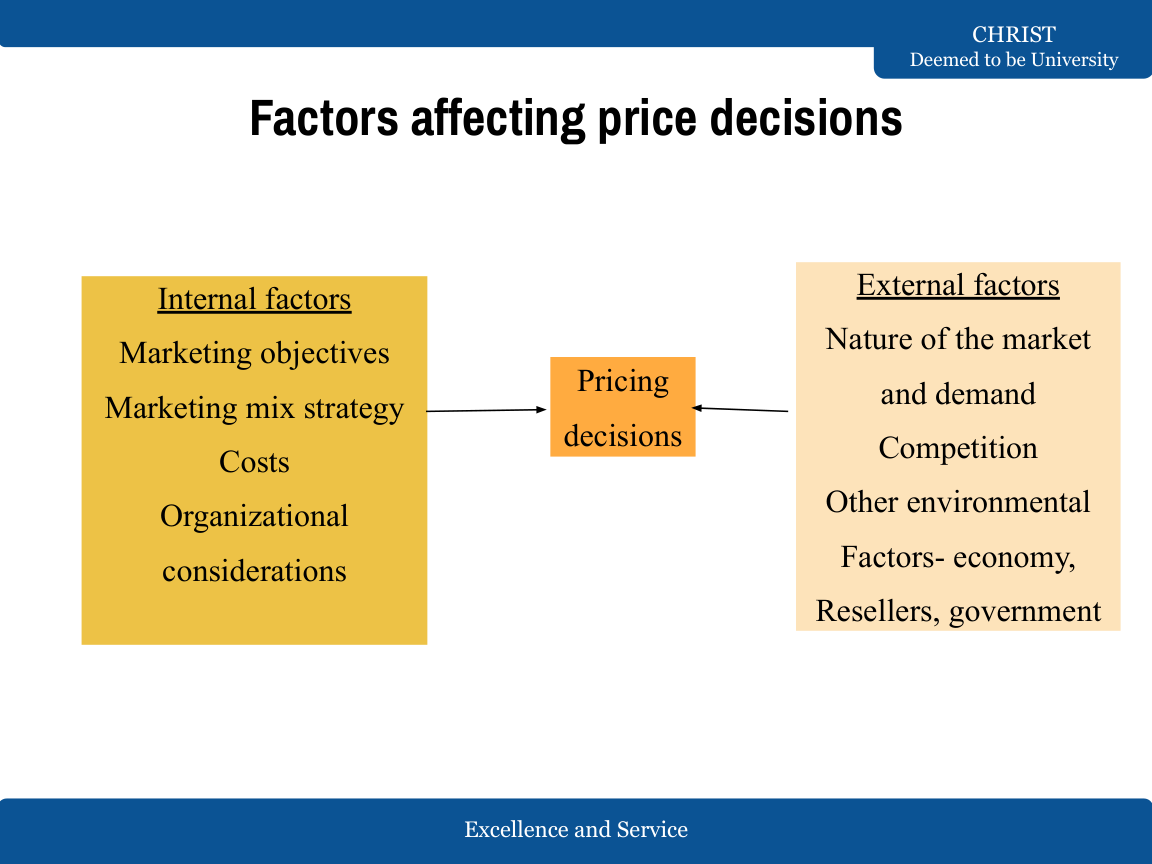
Internal and external pricing factors
Original lecture diagram · PDF page 5. Internal and external pricing factors · Open page

Internal pricing factors

UNDERSTAND THE IDEA

Internal pricing factors come from the business, such as marketing goals, costs, brand strategy and organisational decisions. They limit which prices are practical.

IN REAL LIFE

A bakery checks ingredient costs, target margin and overall marketing goals before setting cake prices. These influences arise inside the business.

External pricing factors

UNDERSTAND THE IDEA

External factors include customer demand, competitors, economic conditions and regulation. Even an efficient business cannot set prices in isolation from its market.

IN REAL LIFE

A bakery reviews local rivals, demand and tax changes before setting prices. These influences come from its market environment.

See the original lecture slides and exact terminology

Original PDF page links are supplied for verification. Some slides use diagrams or split their sentences across lines; the linked PDF is authoritative.

  • View this page in the original lecturer PDF (includes its exact text and diagrams).

Pricing objectives

Profit-oriented pricing objectives

UNDERSTAND THE IDEA

Profit-oriented pricing aims for results such as a target return or maximum profit. A firm may accept lower unit sales if the price better supports its profit goal.

IN REAL LIFE

A shop calculates the margin needed to earn a target return on its equipment. The pricing goal centres on profit.

Sales-oriented pricing objectives

UNDERSTAND THE IDEA

Sales-oriented objectives focus on increasing units sold or market share. A firm may price more aggressively to attract customers even if profit per unit is smaller.

IN REAL LIFE

A cinema reduces weekday ticket prices to increase attendance. The immediate objective is volume or market share.

Status quo pricing objectives

UNDERSTAND THE IDEA

Status quo pricing seeks to keep prices stable or close to competitors. It can reduce disruption when the company values predictable market relationships.

IN REAL LIFE

A fuel station follows the going local price rather than triggering a price contest. Its pricing aims to remain stable relative to competition.

See the original lecture slides and exact terminology

Original PDF page links are supplied for verification. Some slides use diagrams or split their sentences across lines; the linked PDF is authoritative.

  • View this page in the original lecturer PDF (includes its exact text and diagrams).
  • View this page in the original lecturer PDF (includes its exact text and diagrams).
  • View this page in the original lecturer PDF (includes its exact text and diagrams).
04 · Pricing Decisions

Demand, competition and price elasticity

Market demand

UNDERSTAND THE IDEA

Market demand is how much of a product buyers are willing and able to purchase at various prices. Demand, available alternatives and customer need affect the quantity purchased.

IN REAL LIFE

A restaurant notices that its lunchtime seats fill more quickly after price reductions. Customer demand responds to market conditions.

Competition and pricing

UNDERSTAND THE IDEA

Competitors influence the prices customers expect and which alternatives they consider. A company must understand rivals' offers before deciding whether to charge more or less.

IN REAL LIFE

A stationery shop checks equivalent notebook prices in nearby stores. Competitive offers influence its price decision.

Price elasticity of demand

UNDERSTAND THE IDEA

Price elasticity describes how strongly the quantity bought changes when price changes. Demand is elastic if a small price change causes a large change in purchases. It is relatively inelastic if the quantity bought changes only a little.

IN REAL LIFE

A juice shop records how many bottles sell when its price rises slightly. The change in quantity demanded reveals responsiveness to price.

See the original lecture slides and exact terminology

Original PDF page links are supplied for verification. Some slides use diagrams or split their sentences across lines; the linked PDF is authoritative.

  • View this page in the original lecturer PDF (includes its exact text and diagrams).

Cost-plus and break-even pricing

Cost-based pricing

UNDERSTAND THE IDEA

Cost-based pricing begins with the cost of making or selling a product and adds a margin. It is simple to calculate but must still be checked against what customers will pay.

IN REAL LIFE

A tailor lists fabric, labour and overhead costs before quoting for a uniform. The starting point is the cost of providing the offer.

Cost-plus pricing

UNDERSTAND THE IDEA

Cost-plus pricing starts with the cost of making or providing something, then adds an extra amount as profit. If a notebook costs ₹80 to produce and the seller adds ₹20, the price becomes ₹100.

IN REAL LIFE

A bakery calculates ₹60 cost per cake and adds a planned markup. Price is found by adding a margin to cost.

Break-even analysis

UNDERSTAND THE IDEA

Break-even analysis finds the sales level at which total revenue equals total cost. Below that point the activity makes a loss, and above it the business begins to cover its costs.

IN REAL LIFE

A café checks how many coffees it must sell before covering monthly rent and other costs. At the break-even quantity revenue equals total cost.

Target-profit pricing

UNDERSTAND THE IDEA

Target-profit pricing calculates the price or sales volume needed to reach a desired profit. It builds on cost and demand estimates rather than choosing a figure without analysis.

IN REAL LIFE

A gym estimates the membership fee and volume needed to cover costs plus a target profit. Its price is chosen with a planned profit objective.

See the original lecture slides and exact terminology

Original PDF page links are supplied for verification. Some slides use diagrams or split their sentences across lines; the linked PDF is authoritative.

  • View this page in the original lecturer PDF (includes its exact text and diagrams).
  • View this page in the original lecturer PDF (includes its exact text and diagrams).
06 · Pricing Decisions

Buyer value-based pricing

Value-based pricing

UNDERSTAND THE IDEA

Value-based pricing sets the price primarily around the benefits customers believe they receive. Instead of beginning with manufacturing cost, the business asks how useful or valuable the solution feels to the buyer.

IN REAL LIFE

A train-ticket concierge service charges more for a genuine time-saving benefit. Its price reflects value buyers perceive, not only labour cost.

Buyer perceptions of value

UNDERSTAND THE IDEA

Perceived value is the benefit customers believe they will receive relative to the sacrifices required. Strong quality, convenience or trust can affect what someone considers a fair price.

IN REAL LIFE

One family happily pays extra for a durable schoolbag while another chooses the cheapest. The same offering can be valued differently by customers.

See the original lecture slides and exact terminology

Original PDF page links are supplied for verification. Some slides use diagrams or split their sentences across lines; the linked PDF is authoritative.

  • View this page in the original lecturer PDF (includes its exact text and diagrams).

Competition, bid and negotiated pricing

Competition-based pricing

UNDERSTAND THE IDEA

Competition-based pricing uses rival prices as a key reference. A firm might price similarly, lower or higher depending on how its offer differs.

IN REAL LIFE

A local courier service sets delivery charges after studying equivalent regional courier offers. Market rivals are a central reference point.

Bid pricing

UNDERSTAND THE IDEA

Bid pricing is used when sellers submit offers to win a contract or order. The business must choose a competitive bid while covering costs and meeting requirements.

IN REAL LIFE

A contractor submits a sealed quotation for a government office maintenance tender. Winning depends partly on competing bids and the tender criteria.

Negotiated pricing

UNDERSTAND THE IDEA

Negotiated pricing results from discussion between buyer and seller about an acceptable price and conditions. It is common for large or customised purchases.

IN REAL LIFE

A corporate hotel and its client agree on a room rate for recurring staff travel. The price arises from negotiation.

See the original lecture slides and exact terminology

Original PDF page links are supplied for verification. Some slides use diagrams or split their sentences across lines; the linked PDF is authoritative.

  • View this page in the original lecturer PDF (includes its exact text and diagrams).
  • View this page in the original lecturer PDF (includes its exact text and diagrams).

Skimming and penetration strategies

INTERACTIVE EXPLANATIONChoose a strategy

Two opposite launch strategies

PriceTime →

Begin at a high price aimed at early buyers, then reduce it later to reach other customers.

Market-skimming pricing

UNDERSTAND THE IDEA

Skimming means launching a new product at a relatively high price to sell first to buyers willing to pay more. The price may be reduced later to reach a wider audience. It starts high.

IN REAL LIFE

A high-end smartphone launches at a premium aimed at enthusiastic first buyers. The company seeks greater return from customers willing to pay first.

Market-penetration pricing

UNDERSTAND THE IDEA

Penetration pricing means introducing a product at a relatively low price to attract many buyers quickly and gain market share. It starts low, which is the opposite of market skimming.

IN REAL LIFE

A new coffee shop offers a low introductory price to encourage student trial. A lower price helps attract early market share.

See the original lecture slides and exact terminology

Original PDF page links are supplied for verification. Some slides use diagrams or split their sentences across lines; the linked PDF is authoritative.

  • View this page in the original lecturer PDF (includes its exact text and diagrams).
  • View this page in the original lecturer PDF (includes its exact text and diagrams).

Product-mix pricing

Product-line pricing

UNDERSTAND THE IDEA

Product-line pricing sets different prices for related versions of an offering. The differences should reflect real changes in quality, features or customer benefits.

IN REAL LIFE

A company sells basic, standard and premium headphones at stepped prices. Each price reflects a different level within the range.

Optional-product pricing

UNDERSTAND THE IDEA

Optional-product pricing sets separate charges for add-ons that customers may choose with the main product. A car's optional equipment is a typical example.

IN REAL LIFE

A car showroom charges separately for an optional upgraded sound system. The accessory adds to the main product price.

Captive-product pricing

UNDERSTAND THE IDEA

Captive-product pricing applies when customers need a compatible item to keep using the main product. A printer and its replacement ink are a familiar example.

IN REAL LIFE

A printer is inexpensive, but buyers must regularly purchase compatible ink. The main product and necessary consumables are priced together strategically.

By-product pricing

UNDERSTAND THE IDEA

By-product pricing earns revenue from secondary materials created during production. Selling those materials can help reduce the effective cost of the main product.

IN REAL LIFE

A sawmill sells wood offcuts to a local biomass producer. Revenue from a lower-value by-product helps recover costs.

Product-bundle pricing

UNDERSTAND THE IDEA

Bundle pricing sells several items or services together for one combined amount. The bundle should offer value compared with buying the pieces separately.

IN REAL LIFE

A cinema sells one package containing a ticket, drink and popcorn. Several products are offered together at a combined price.

See the original lecture slides and exact terminology

Original PDF page links are supplied for verification. Some slides use diagrams or split their sentences across lines; the linked PDF is authoritative.

  • View this page in the original lecturer PDF (includes its exact text and diagrams).
  • View this page in the original lecturer PDF (includes its exact text and diagrams).
  • View this page in the original lecturer PDF (includes its exact text and diagrams).

Discount and allowance pricing

Cash discount

UNDERSTAND THE IDEA

A cash discount reduces the amount due when the buyer pays promptly or early. The seller uses it to encourage timely collection of payments.

IN REAL LIFE

A wholesaler offers a small discount when a retailer pays an invoice promptly. The incentive rewards early payment.

Quantity discount

UNDERSTAND THE IDEA

A quantity discount offers a lower unit price when customers buy larger amounts. It can encourage bigger orders or reduce handling costs.

IN REAL LIFE

A supplier quotes a lower unit price to a bookstore ordering 500 notebooks. Larger purchase volume earns a price reduction.

Seasonal discount

UNDERSTAND THE IDEA

A seasonal discount lowers prices during off-peak periods or when demand is weaker. It helps manage stocks and use otherwise idle capacity.

IN REAL LIFE

A hotel offers lower room rates during its traditionally quiet season. A seasonal price reduction stimulates demand.

Trade discount

UNDERSTAND THE IDEA

A trade discount rewards channel intermediaries, such as retailers, for carrying out selling or distribution functions. It differs from a consumer coupon.

IN REAL LIFE

A manufacturer gives authorised dealers a reduction from the list price. The allowance recognises intermediary functions.

Allowances

UNDERSTAND THE IDEA

An allowance is a price reduction or credit for a specific activity such as trading in an old product or supporting promotion. It is not always the same as a standard discount.

IN REAL LIFE

A phone dealer discounts a new device when a customer trades in an eligible older model. The transaction uses a price allowance.

See the original lecture slides and exact terminology

Original PDF page links are supplied for verification. Some slides use diagrams or split their sentences across lines; the linked PDF is authoritative.

  • View this page in the original lecturer PDF (includes its exact text and diagrams).
  • View this page in the original lecturer PDF (includes its exact text and diagrams).
11 · Pricing Decisions

Segmented pricing

Segmented pricing

UNDERSTAND THE IDEA

Segmented pricing charges different groups or situations different prices when the difference is not solely due to costs. Businesses need to consider fairness and applicable rules.

IN REAL LIFE

A museum provides different stated entry rates for students and standard visitors. The price differs by customer segment.

Customer-segment pricing

UNDERSTAND THE IDEA

Customer-segment pricing uses a customer's eligibility or group to offer different rates. Student tickets are a familiar example where conditions are stated clearly.

IN REAL LIFE

A theatre offers a student price on proof of a valid student card. Two customer groups pay different prices for access.

Location-based pricing

UNDERSTAND THE IDEA

Location-based pricing charges different amounts based on where an offering is provided or used. A seat's position in an auditorium may change its price.

IN REAL LIFE

A concert hall charges different amounts for front-row and upper-tier seats. The specific location changes the perceived value and price.

See the original lecture slides and exact terminology

Original PDF page links are supplied for verification. Some slides use diagrams or split their sentences across lines; the linked PDF is authoritative.

  • View this page in the original lecturer PDF (includes its exact text and diagrams).

Psychological and promotional pricing

Psychological pricing

UNDERSTAND THE IDEA

Psychological pricing considers how prices are interpreted, not just their mathematical amount. A price ending in 99 may feel different from a rounded figure even when the difference is tiny.

IN REAL LIFE

A retailer prices a T-shirt at ₹999 rather than ₹1,000. The presentation of price can affect buyer perception.

Promotional pricing

UNDERSTAND THE IDEA

Promotional pricing uses a temporary offer to encourage immediate purchase or trial. The reduced price should have a genuine and clearly communicated duration.

IN REAL LIFE

A shop offers a legitimate weekend reduction for a selected product. The temporary incentive is designed to generate short-term demand.

See the original lecture slides and exact terminology

Original PDF page links are supplied for verification. Some slides use diagrams or split their sentences across lines; the linked PDF is authoritative.

  • View this page in the original lecturer PDF (includes its exact text and diagrams).
  • View this page in the original lecturer PDF (includes its exact text and diagrams).
13 · Pricing Decisions

Geographical and international pricing

Geographical pricing

UNDERSTAND THE IDEA

Geographical pricing changes the delivered price according to location or transport arrangements. Freight, distance and distribution costs can affect the amount paid.

IN REAL LIFE

A furniture maker adds transport charges for customers in distant districts. Delivery location affects the final selling price.

International pricing

UNDERSTAND THE IDEA

International pricing adapts prices across countries to local purchasing power, tax, currency and competition. The same product need not cost the same everywhere.

IN REAL LIFE

A phone company reviews exchange rates and local taxes when pricing in two countries. The same product may need different market-specific prices.

Price changes

UNDERSTAND THE IDEA

Businesses may raise or lower prices in response to costs, demand or competition. They should consider customer reactions and the effects on sales volume and reputation.

IN REAL LIFE

A bakery prepares to revise cake prices after a major rise in butter costs. Management must weigh business costs against likely customer reactions.

See the original lecture slides and exact terminology

Original PDF page links are supplied for verification. Some slides use diagrams or split their sentences across lines; the linked PDF is authoritative.

  • View this page in the original lecturer PDF (includes its exact text and diagrams).
Complete chapter index
Source-backed coverage

Coverage & original slides

All 13 teaching sections in this chapter group are listed below. Original lecture slides are linked within each section so you can verify important terms, diagrams and lists.

Source material

These are notes based on the uploaded Marketing Management lecture PDFs. Examples added to explain a concept are illustrative, not quotations from the lecturer.

Uploaded source documents

Complete teaching index

YOU HAVE REACHED THE END OF THIS CHAPTER

Next chapter · 04

Distribution
YOUR PRIVATE NOTES

Saved passages.

Passages are saved on this device. Export a copy if you may change devices.

ORIGINAL LECTURE PDF

Source slide

Check the original lecturer material without leaving your notes.

Open PDF in a new tab ↗

Find your place.

Choose any lesson. You can also type a topic name to filter the list.